Will the University of Tokyo Change? The Social Responsibility of the University of Tokyo

→Japanese

It has recently been reported that the University of Tokyo has been looking into the idea of starting fall entrance and summer graduation, a norm of college/university academic year of many countries.

What is the meaning of such a move?  Of course, it would be significant because it would bring the academic year of the University of Tokyo into line with major universities in most of the countries around the world.  It would have a ripple effect in so many ways including the promotion of international exchange between universities and making it possible to transfer between universities that are in different countries; enhance the mobility of faculty and students between Japan and the rest of the world.

This experiment has also yet to actually be approved overall by the authorities, Ministry of Education, but it would be possible to introduce the semester system and also thus have summer graduation (as well as fall entrance).  Some of the students at some universities do graduate in the summer (with a full-fledged graduation ceremony) and enter university in the fall, but these universities do not really hold much impact over Japanese society at large.  Moreover, since almost all major Japanese companies, civil service and other branches of Japanese society only hire new college graduate in the spring, what do the students who graduate in the summer do about trying to find a job?

Universities can do little to challenge major corporations which are set in their ways and resistant to change such as the long-standing practice of hiring of new graduates in one fell swoop.  At the very least, those students who have put off graduation for a year and not yet accepted a job within a company should still be considered new graduates.  Finding employment is difficult for university students regardless of the schedule (to say nothing of the difficulty that high school students are having trying to enter the job market), particularly at the time of economic difficulties like today.  Universities thus have no incentive to look seriously into the idea of a summer graduation.

Japanese society, at large, runs on a schedule of “start school in April and graduate in March” which makes it impossible to even really discuss the matter despite the growing need for internationalization.  Thus, Japanese universities and international society are inherently mismatched.

Thus, the fact that the University of Tokyo has begun to consider the idea of a fall graduation could be characterized as a challenge to this mismatch between globalization and the Japanese society with the summer graduation.  The real reason behind this move may actually be different, I just do not know, but this has been its ultimate impact.

The individual who brought up these points is Shigeyuki Jo (in Japanese).  I have followed Jo-san with his spirit of a maverick and his support of the youth, thus have been supporting him from behind.  It came as no surprise that this thoughtful opinion came from Shigeyuki Jo (in Japanese).

Moreover, it is hugely important that the University of Tokyo be the first university to put pressure on Japanese universities and the university system as well as society at large to change.  Such actions would not have much of value if they were taken up by another university, because the idea would not be picked up by the media and they would have almost no impact on society.

Thus, if the Japanese social system is ever going to adapt to the global schedule, everyone has to do their part. If the most influential university in Japan does not take action, then nothing will happen. This is the responsibility that comes with being a leader in the society of ‘Japan Inc.’  That is why I often refer to the leading role that the University of Tokyo should exercise often in my lecturings and speeches.

The same logical argument can be made for the role of the university hospital in the restructuring the ‘medical’ care system (or better characterized as the structuring of the ‘health’ care system) and I made this argument in a book I authored entitled The University Hospital Revolution (published in Japanese). I am not sure how much this book has attracted attention . . .

So what will happen?  Will the University of Tokyo lead the way for the restructuring of Japan?


New Research Graduate School in Okinawa

→Japanese

I have previously introduced in this blog, OIST, (Ref. 1, 2) a research institute which was established in Okinawa and is designed to take on the challenges of the new global world. 

The plan is to make this research institute into a full-fledged graduate school, and I am part of the group which is responsible for making this happen.  In a previous column, I talked about sitting in on a board of governor’s meeting via teleconference from Kuala Lumpur, but unfortunately was unable to fully participate due to a bad connection.

This board of governors did, however, succeed in moving this project a further step ahead.

The possibility of becoming a groundbreaking graduate school has catch the attention of the world at large with many questioning whether something like this on this scale is really happening in Japan.  Two articles have been published in Nature entitled “Okinawa goes Recruiting” and “Made in Japan” in the wake of the executive committee meeting. I look forward to more of these types of articles appearing in the future.

It has been a long hard journey to get this far.  I would like to offer my sincere and heartfelt thanks to everyone involved in this endeavor including Drs. Sydney Brenner, Jonathan Dorfan and Torsent Wiesel, and all other preeminent supporters and organizations representing a variety of fields from around the world, and within Japan.

The real challenges lie ahead of us.  We will need the help and support of everyone to ensure that scientists around the world recognize OIST as a graduate research facility in an opening and welcoming Japan.  In many ways, I think that intentions of Japan as a country and the confidence of researchers are intertwined. 

I am extremely pleased with the progress that is being made and I humbly ask everyone here and of the world for their support.


Dialogue with Ikujiro Nonaka: An Event at a Gathering of the UCB-UCLA Alumni Association

→Japanese

Ikujiro Nonaka is one of Japan’s most influential ‘gurus’ on innovation.  He is a highly regarded international scholar and someone I also greatly respect.  Professor Nonaka has written many wonderful books (in Japanese and in English), and among them are some of my favorites.  Included among these books are “The Essence of Defeat”, “The Essence of Innovation”, “The Etiquette of Innovation” and “Virtuous-Based Management”.  His ability to conduct research and analysis, and then find the “essence” of a thing is truly amazing.

Moreover, Professor Nonaka does not just look, in his books and talks, at the analysis and know-how that forms the foundation of the average business school, but rather he strives to delve into the essence of a thing as well as delve into “leadership” and shared philosophy which exposes the humanity at the root of all. Specifically, Professor Nonaka looks at the importance of phronesis as proposed by Aristotle.  He could even be characterized as Japan’s Peter Drucker.  And in reality, he is the First Distinguished Drucker Scholar in Residence at the Drucker School of Management, Claremont Graduate University.

We had previously had some discussions, and we have worked together on various projects in his role as the head of the University of California at Berkeley (UCB) Japan Alumni Association and mine as the head of the UCLA Japan Alumni Association (in Japanese).

One of our projects that came to fruition is our dialogue on “Japanese Innovation in the Aftermath of the 3.11 Disaster ? What Will It Take?” which was held on July 1st.  This event was well attended by a lively audience.  The event started from 6:30 in the evening and the reception continued on until 10:00 pm.  Unfortunately Professor Nonaka had to leave early because he had to leave for Dalian the next day. 

The Hitotsubashi Business Review has recently put out a special feature entitled Thoughts on Ikujiro Nonaka: Frontiers of Knowledge Management (in Japanese) in its Summer Issue.

I started out by setting the tone for the first 30 minutes and reiterated the themes that I have talked about on this site at length.  For example, how both the strengths and the weaknesses of Japan have been laid open to the world in the aftermath of the events of 3.11 (Ref. 1, 2) .

Professor Nonaka has also coauthored a paper The Wise Leader with Hirotaka Takeuchi that was just published in the May issue of the Harvard Business Review.  (Professor Takeuchi launched the Graduate School of International Corporate Strategy at Hitotsubashi University 10 years ago and last year returned to Harvard.)  Anyway we launched into our dialogue for 30 minutes which was followed by a 60-minute Q&A session.  All in all, it was a hugely intellectually stimulating evening.

Professor Nonaka and myself both strongly stressed the importance of, not knowledge, but rather the spirit that one can garner from liberal arts, philosophical and communal values as well as wisdom and experience gained through practical application, actions and evaluations.

At the same time, the July issue of Voice (in Japanese) had a special feature on “The Kan Administration, the Essence of Defeat”, and Professor Nonaka lead off with an article entitled “Non-Reality-Based Politicians are Destroying Our Country”.  Professor Nonaka noted during the talk that sales of his book The Essence of Defeat have jumped since 3.11.

Our dialogue should eventually be available for all to see via video and I will let you all know when it is posted.

I received a number of messages via Twitter and email from participants, and someone also talked about this event in their blog (in Japanese).

Afterwards, I was able to enjoy drinks with Mr. Kobayashi who is the originator of “This is Liberal Arts: Summer Course 2011” that was conceived in Boston last year, and his friend Mr. Kano, Mr. Yasui and Mr. Yokoyama who is a UCLA alumni.

After spending several fulfilling hours with everyone, a truly productive day came to an end.


Message of Support to Female University Students and an Email from a Student

→Japanese

Those of you who visit my site are probably aware that I am a proud supporter of the empowerment of women (in Japanese).   I have often talked in public on this theme (in Japanese).

I gave a talk at Showa Women’s University whose president is Mariko Bando.  President Bando is also widely known as the author of numerous books including a best-selling book, The Dignity of a Woman.  The lecture at the Hitomi Memorial Hall was open to the general public and approximately 2,000 were in attendance, most of whom were students.

As I have reiterated numerous times on this site, (Ref. 1, 2, 3) the disaster of 3.11 has made the weakness of the Japanese male-centric hierarchical social structure apparent to the rest of the world and has, in turn, prompted talk about this state of affairs.  This demonstrates the almost frightening power of the information age.  My talk focused on these topics as well as the great expectations for women in the modern age.

The discussion moved onto topics such as “students should take time off during their school years”, the direction that women are moving into in the global world and actual examples of their activities.  I truly hope that each and every one of them is able to find a career that allows them to have a wonderful life.

I also made a request to the president and the Chairman of the board that students not be required to pay tuition when they take a leave from school.

I received a number of messages via Twitter, and also emails such as this one:

“My name is “M” and I am a fourth year student in the Department of Psychology in the Social Science Faculty at Showa Women’s University.  I attended your lecture today at Showa Women’s University and I wanted to thank you for your very interesting and thoughtful talk.  I am sending this mail, because I really wanted to convey what I took away from today’s lecture.

I listened to what you had to say, I came to realize that what we need to do is first give ourselves permission to take on challenges and strive to maintain our drive and passion as we tackle these challenges.

I also think that if we look at our homeland of Japan from the outside, we would gain a new and different perspective on things in comparison with our current perspective.

Since the events of 3.11, I have come to doubt much of what I had hitherto accepted without question.

However, I now strongly feel that it is our job to change what Japan has become.

Nothing will happen unless people like myself do something.  I just wanted to let you know that I have taken your exhortations to heart and will try my best to do whatever I can to help achieve change. . . .

Thank you so much for your efforts of today.”

It always pleases me when I get such a response from students that holds the promise of the beginning of something new and becoming connected.


“This is Liberal Arts: Summer Course 2011” by Harvard College students

Japanese

I noted in previous blog articles (Ref 1 in Japanese) that the number of students from Japanese going to top universities in the United States is dropping which caused quite a stir. This drop is a fact but it is different from the problem that the youth of today do not want to venture into the outside world. 

I have pointed this out a countless number of times (Ref. 1 2) and explained the reasons why. I look forward to picking up this topic for further discussion at a later time. 

I think you all know from the contents of this site that I make as much effort as possible to interact with the Japanese youth when I go abroad.  As you know, I get together with a lot of youth who are engaged in research in Boston, primarily in Harvard and MIT. 

The planning of this summer course on the liberal arts started as part of these interactions when Ryosuke Kobayashi, who was a sophomore at Harvard College last year came to the realization that liberal arts education is extremely important and he felt the need to convey this importance to Japanese high school students.

We discussed how to concretely get this message across in the course of emails and meetings when he visited Japan, and finally an actual course entitled “This is Liberal Arts: Summer School 2011” will be offered for one week at the end of August from the 20th to the 27th.

The main sponsor is Impact Japan which was launched last year.  The Summer Camp receives support from many individuals and groups. This Summer Camp will be attended by 25 students from Harvard, 30 students from Japanese universities and target approximately 80 high school students.  You can take a look here for more information. 

We are looking for highly motivated high school students to join us.

The Camp is scheduled to be held at GRIPS which I am affiliated with and other locations around Roppongi.

We are currently putting together what promises to be a great curriculum that will address the questions such as “why the liberal arts?” and “what are the liberal arts?” and more.

All in all, it should be a very enjoyable experience.


An Interview with NBR

Japanese

My opinions on the response of Japan to the 3.11 Tohoku Earthquake and Tsunami Disaster and the Fukushima nuclear disaster have been posted on the NBR website. This interview is entitled “Moving Forward: Relief Efforts, Health System Reforms, and Japan’s Role in Global Aid”.

Among the things that I discuss in the this interview is the establishment of an independent, international task force, to examine Fukushima nuclear disaster, which also serves to halt the loss of confidence and damaging rumor mongering in Japan.  The establishment of such task force is critically important, thus the government must take immediate action, and adopt a stance designed to learn from the mistakes of the past and share those lessons learned with the rest of the world.

I just want to ask you, dear readers, what message did you take away from this interview?

Interviews of a number of other friends (ref.1)and acquaintance have also been posted, and I encourage you to take a look.  Not an awful lot of news in English gets out of Japan, so many in the general public overseas look upon Japan with uncertainty because they are unsure of what is going on. 

However, we are in an age of new tools and venues for communication.  I, myself, have decided to try to send out at least half of my messages on Twitter in English.


An Invitation to a Dialogue with Yoko Ishikura

Japanese

The 16th International Conference for Women in Business will be held on Saturday July 23rd at the Grand Pacific Le Daiba. The theme of this conference is “Acting and connecting beyond borders.”

This event is the brainchild of Kaori Sasaki who is the CEO of eWoman, Inc.  Keeping in mind the need to save electricity, the doors to the conference rooms will open at 7:00 a.m. and the conference itself will start bright and early at 8:00 a.m.  There will be a networking lunch with the conference ending at 2:00 p.m.

You can take a look at the program here. The conference itself promises to be extremely thought provoking and I will be participating in the form of a dialogue with Yoko Ishikura in a session entitled “Connecting beyond borders”.  She has recently published a book entitled Global Careers (in Japanese). She has also moved over to Keio University in April and is taking on new challenges.  I anticipate that my dialogue with Professor Ishikura will be fun and lively.

Participation is not restricted to women and Japanese/English simultaneous interpretation will be provided.  I look forward to seeing you there!

You can sign up via the conference website.  However, I must say that the conference fee is just a little on the high side.


An Essential Condition for Education in the Age of Globalization: The Importance of Real Life Experience in the “Outside” World

→Japanese

One thing that I am prone to repeat persistently in this site and other arenas as well is that the young (and particularly the youth of Japan) should take the leap and leave the comfort of their home ground behind! The world is becoming flatter in a figurative sense, and it is important for the youth of Japan to actually see it up close and experience for themselves what it is to see the outside world and also Japan from the outside looking in.

One thing that I am prone to repeat persistently in this site and other arenas as well is that the young (and particularly the youth of Japan) should take the leap and leave the comfort of their home ground behind! The world is becoming flatter in a figurative sense, and it is important for the youth of Japan to actually see it up close and experience for themselves what it is to see the outside world and also Japan from the outside looking in.

The network of friends and relationships that a person makes when he or she is young is a valuable asset, and those connections established with others in the course of overseas experiences when young will serve to become great assets and a treasure with global value in the years to come.

However, myself and many others like Yoko Ishikura (see her book in Japanese) who push the idea of studying overseas during high school or college or even taking time off from studies to get a taste of what it is like to live overseas.  Unfortunately, while many in Japanese society promote the idea of things like a “gap year”, the reality is that measures and reforms have yet to be put into place that ensure ‘ordinary’ employment for those individuals who decide to “take off” two to three years after http://krkwtest.com/en/wp-content/uploads/typepad/201105131044.pdfgraduation from university.

I recently have written several papers related to this subject: Reforming the Healthcare Personnel Education System – Social System and Personnel Resource Innovations(in Japanese) which was published in IDE, a journal read widely by educators  and Push the Young Out of the Nest: Why Is International Exchange Important? which was published in Chemistry and Chemical Industry, a journal read widely by academics and company employees in the field of chemistry.

While others may not agree with my opinion, those who offer up reasons for not leaving Japan are doing a disservice to youth of Japan who are our future. Youth should have the option to embark on these experiences and it is the duty of adults to support and facilitate these choices.

However, as I have pointed out again and again on this site (in Japanese), (Ref. 1, 2, 3, 4) the events of ‘3.11’ have made the weaknesses of the Japanese social structure painfully obvious.

The only real path that Japan has for its own future is to nurture and educate as many individuals as possible who have the desire to spread their wings and experience the new global world.


An Invitation to a Dialogue with Professor Ikujiro Nonaka

→Japanese

The University of California (UC) is system of universities with 10 campuses located throughout the state of California and it is one of the leading university systems in the United States. The schools in Berkeley and Los Angeles have the largest numbers of Japanese alumni. 

How would you like to attend a conversation between myself and Professor Ikujiro Nonaka on the topic of “Japanese Innovation in the Aftermath of the Recent Disaster ? What Will It Take?” sponsored by the joint secretariat of the UCLA Japan Alumni Association and UC Berkeley Japan Alumni. This Dialogue will be held on July 1st from 6:30 pm at the Tokyo 21c Club.

You do not need to be a member of the UC alumni association.  I would really love to have a chance to meet and talk with everyone and anyone who follows this blog.

***************

The 4th Berkeley Arena of Wisdom

“Japanese Innovation in the Aftermath of the Recent Disaster ? What Will It Take?”

UC Berkeley Japan Alumni Chairman: Ikujiro Nonaka

UCLA Japan Alumni Chairman: Kiyoshi Kurokawa


■ Date: July 1st, 2011 (Fri) 6:30 PM to 9:30 PM

■ Location: Tokyo 21c Club (Shin-Marunouchi Bldg 10F)

■ Fee: UCB・UCLA members 3,000 yen (Food included but beverages separate)

            UCB・UCLA non-members 4,000 yen (Food included but beverages separate)

Professors Nonaka and Kurokawa will both participate in the reception to be held after the seminar. (Drinks are to be paid for at the time of receipt.)

■ The language of the Dialogue will be Japanese in principle with an accompanying PowerPoint presentation in English (however, questions in English are more than welcomed).

■ RSVP (deadline for registration): Please fill out the registration form by June 28th.

***************


A summary of this upcoming event.

●    The 4th Berkeley Arena of Wisdom will be jointly sponsored by the UCLA and Berkeley Alumni Associations.

●    We asked the alumni chairmen to host Kiyoshi Kurokawa who is a past Professor of Medicine at UCLA and Ikujiro Nonaka who is the Fuji-Xerox Professor of Knowledge at Berkeley and these two individuals are internationally recognized scholars in the area of innovation.

●    We will be able to become better acquainted with SECI model as proposed by Professor Nonaka, based on spirals formed by tacit knowledge and explicit knowledge if there are substantial contributions to the creation of science and technology policies through the use of state funds on one hand and innovation by well-positioned corporations which are sitting on a wealth of R&D. 

●    Japan will be unable to rebuild in the wake of the recent  disaster without innovation. The secretariat of the alumni association aims to expand the Berkeley Arena of Wisdom through this talk on Japanese innovation in the aftermath of the earthquake and tsunami by the two guests. 

●    The two speakers have made their views known in the media on the overwhelming scale of the local disaster and problems surrounding leadership. The events surrounding the Fukushima nuclear reactor have made it clear that the concepts of “phronesis” as espoused by Professor Nonaka and "out-of-the-box" thinking by Professor Kurokawa as extremely relevant to the issues related to leadership in a knowledge-based society.

●    The two speakers plan on keeping their remarks brief with each speaker talking for about 30 minutes while raising and commenting on important issues. The hope is that the talk can develop into a deep discussion with attendees (however, all should be warned that given Professor Kurokawa’s love of a good debate who knows what could develop!!)

●    The language of the Talk will be in Japanese (but we may switch to English on occasion to accommodate inquiries from attendees).

●    A reception with food will be held after the seminar which will allow time for attendees to talk and get to know each other.  However, drinks are not included and should be paid for at the time of receipt. 

●    All funds collected for the seminar will be donated to disaster relief for the victims of the Tohoku Earthquake.

Mavericks Moving into New Frontiers

→ Japanese

I departed from Kuala Lumpur and arrived at Narita early on the morning of the 17th. 

The Okinawa Institute of Science and Technology (OIST) has entered in the final stage of preparations to be certified as an official graduate school.  Meetings of the executive committee were held on the 16th and 17th.  I was unable to effectively participate in because the teleconferencing connection from Kuala Lumpur was bad and the connection wasn’t much better during the final morning session on the 17th after I returned to Tokyo. So unfortunately my input during these meetings was minimal.

OIST may very well become an international research facility that leads us into a new era. This type of approach qualifies as “going rogue” in Japan, but the OIST represents a hugely important project as we move into the future. This endeavor is, without question, deserving of our support.

I sat down in the afternoon for a talk with Dr. Robert W. Conn, CEO of the Kavli Foundation, Hitoshi Murayama of the IPMU at the University of Tokyo (which is a global research institute in the real sense of the word) and a few others. Dr. Murayama (Ref. 1) is one of only a handful of truly global leaders in opening new science frontiers. The IPMU is an institute which has become well known throughout the world over the past several year for its superior and, one could even say, unique approach, and has received the global “stamp of approval.” Dr. Murayama also gave a presentation at TEDxTokyo2010

Drs. Kalvi  and Conn are true “mavericks.” They had just met ten days before with President Obama at the White House with the 2010 Kavli Laureates. 

Dr. Conn and I crossed paths at UCLA and he often reads this blog. We are kindred spirits and our conversations are quickly became very lively. Since the mission of the Kalvi Foundation is to provide backup for leading university research labs around the world and support research in the areas of space, nanoscience, and neuroscience, we had plenty to talk about. I really hope that we can work together here in Japan. 

Dr. Maruyama is cut from the same mold as Joi Ito, the newly appointed head of the MIT Media Lab, whom I introduced on this blog, and I was pleased to be able to engage him, as he happened to be in Tokyo, in stimulating conversation.

I really hope that we can also send more graduate students from Japan to the Media Lab.

Murayama-san and Ito-san are both Japanese mavericks of the global world. I think it is essential for the revitalization of Japan, that we see more of these mavericks in Japan.


Kuala Lumpur – Pacific Science Congress

→Japanese

I had the honor of being appointed eight years ago to the Presidency of the Pacific Science Association (PSA) and we held the 2007 Pacific Science Congress in Okinawa and then the 2009 Inter-Congress in Tahiti (Ref 1, 2, 3).  I have already, as you may know, talked about these gatherings on this site.

The Pacific Science Congress also has a committee within the Japan Science Council and belongs to the International Council of Science (ICSU).  This organization has a long and illustrious history of 98 years.

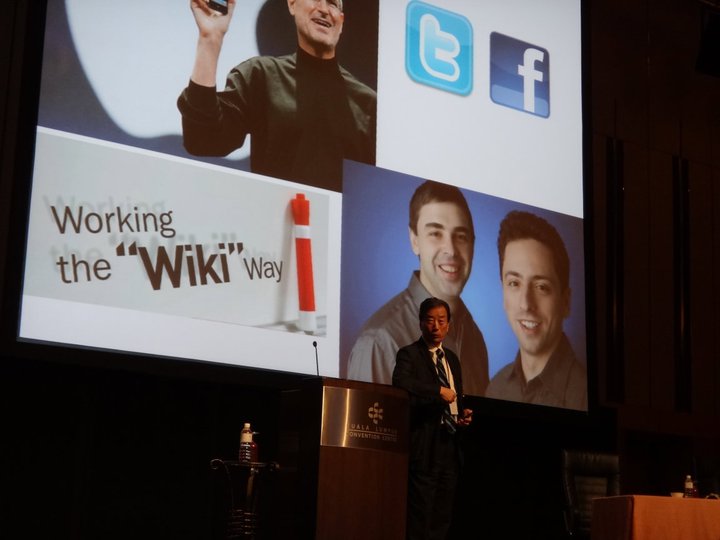
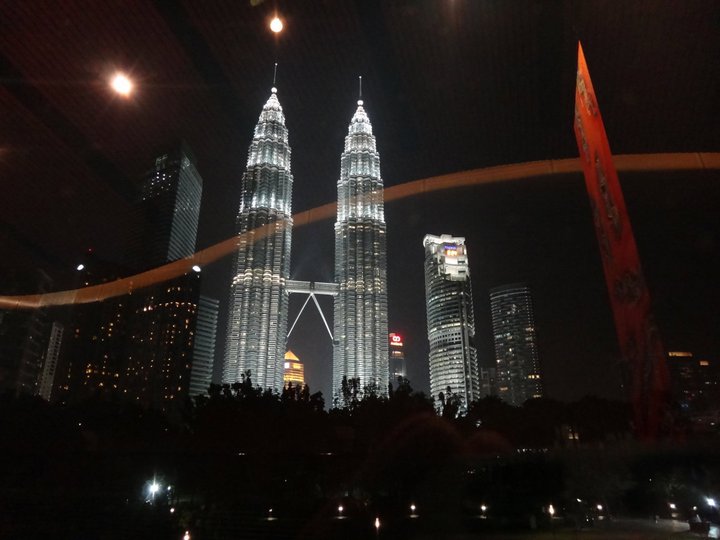
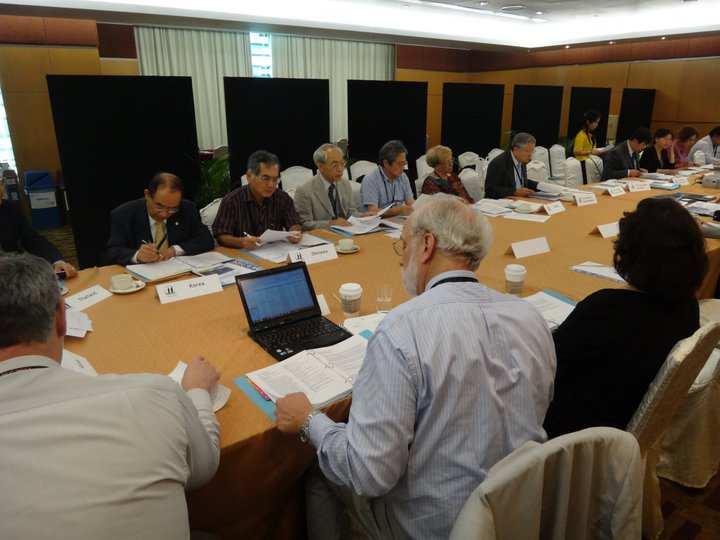
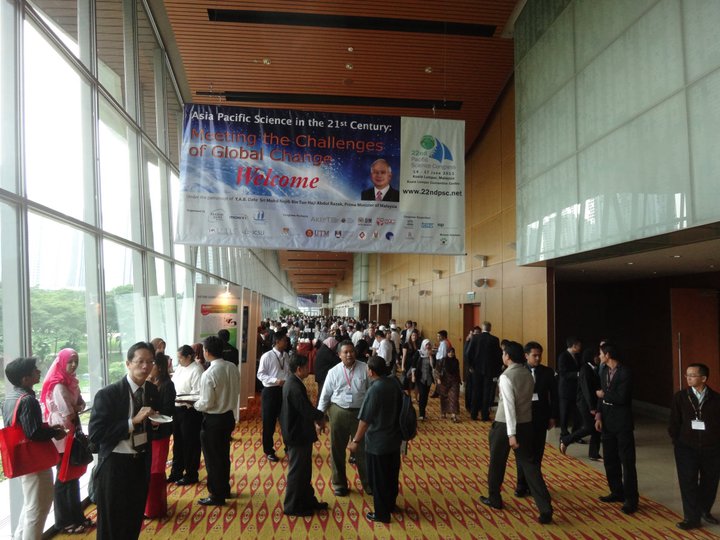
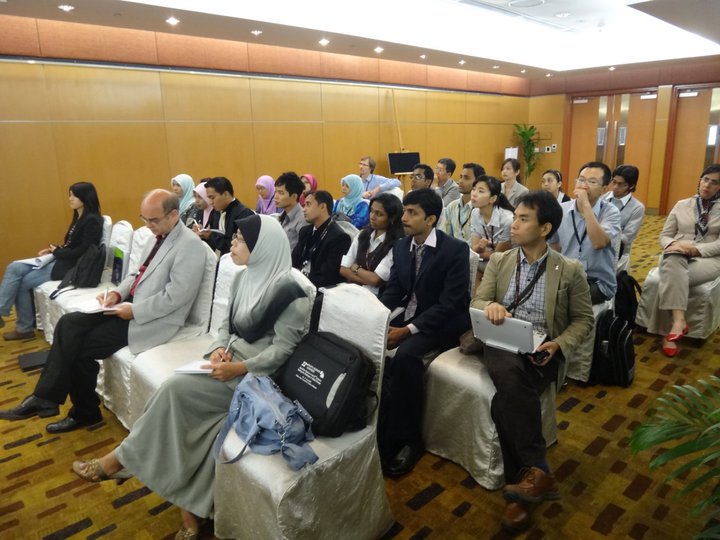
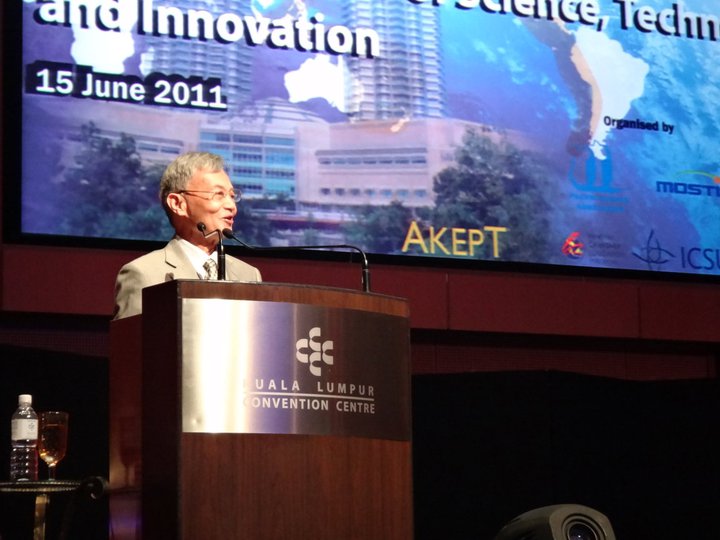
The Congress was held this year in Kuala Lumpur from June 14th to June 17th, and as the Immediate Past-President, I was invited to give a Keynote address.  I departed on the 13th for Kuala Lumpur.

Malaysia is a country that is vibrant and growing and it is pouring its energies into policies designed to promote education along with scientific and technological innovation.  Many local researchers who receive backing from the government were in attendance at the conference making for a really excellent gathering.

The title of my Keynote address was “Age of Uncertainty: Have We Become Wiser?” and my objective was to be as stimulating and thought provoking as possible.  Of course, many in the audience also expressed their support, concern and condolences regarding the recent tsunami and the subsequent events in Fukushima.

Everyone present seemed to find my address interesting and it prompted numerous questions from the audience.  The next day I even sat down for a live TV interview that lasted approximately 25 minutes. I was pleased to find out that Greg-san from Nagasaki University observed on his blog that the spirt in the room during my address heightened.

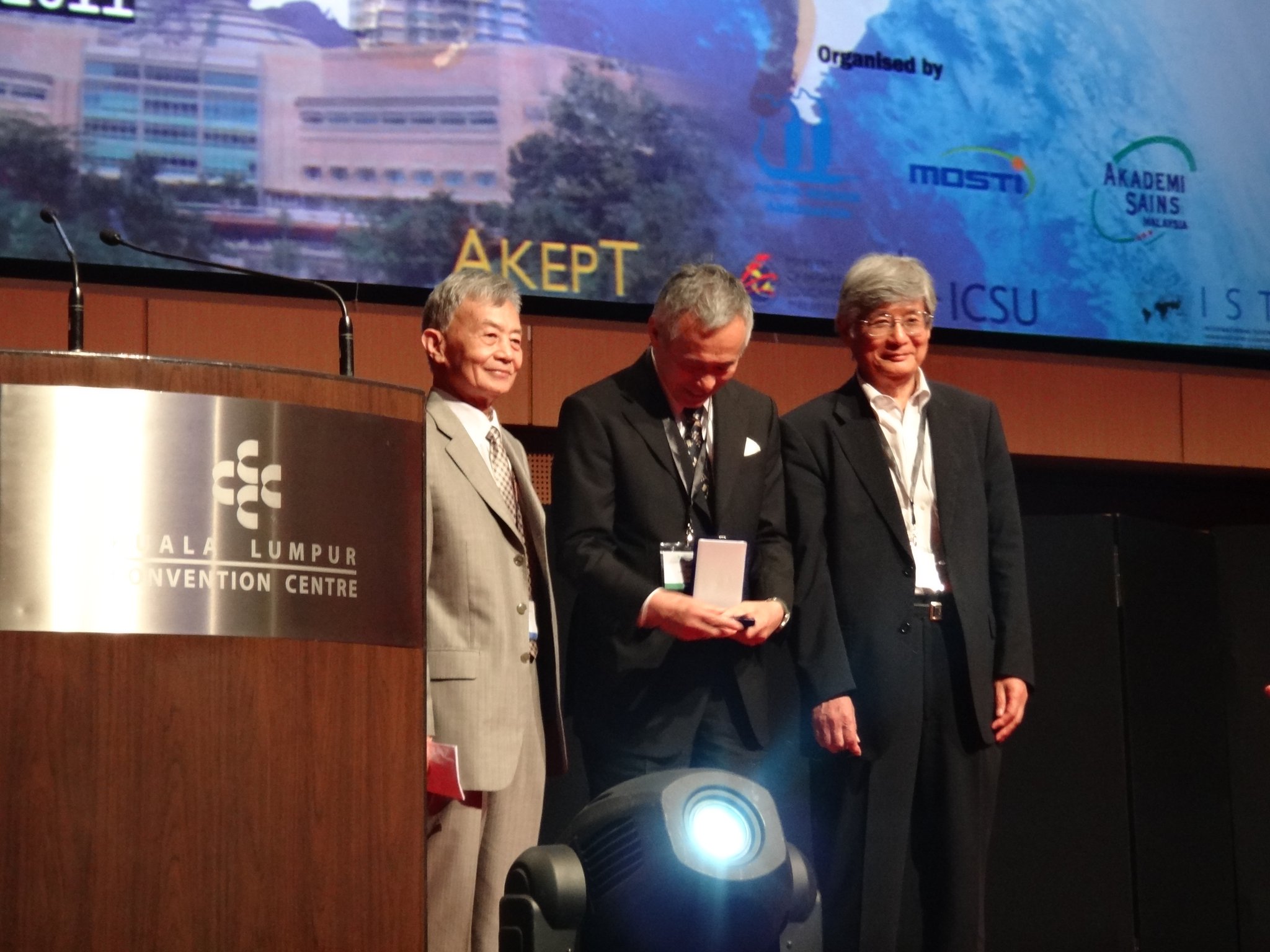
The Japan Science Council’s Hatai Medal was awarded this year to Professor Katsumi Tsukamoto (Ref. 1) for his research on the origin and migration of Pacific eels.  Professor Tsukamoto picked up his award in the company of his wife and I want to offer him my heartfelt congratulations on receiving this honor. 

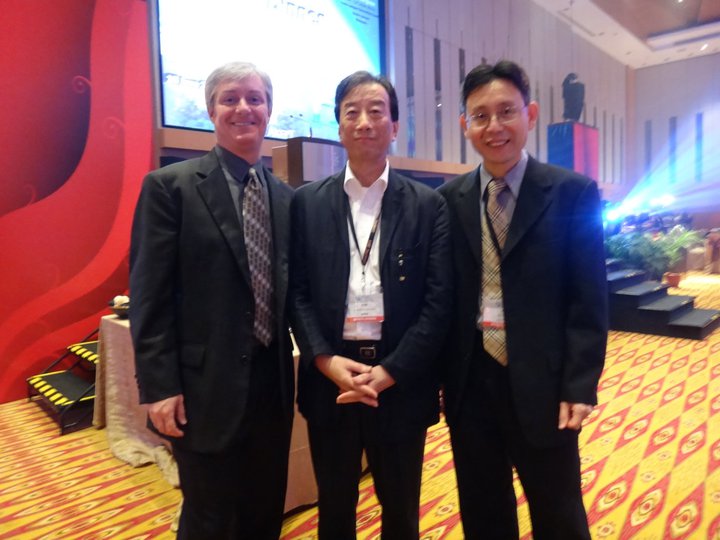
I also was able to meet up with Dr. Robert Underwood (left photo below) who is the President of the University of Guam and had served in the U.S. House of Representatives from 1993 to 2003.  He talked about the far-flung Pacific Islands including the problems they grapple with in the areas of education and health care as well as their unique relationship with the United States from an extremely interesting perspective. He extended an invitation to me to visit Guam and I think that I would like to take him up on his offer sometime within the next year.  The Congress was an overall enjoyable experience which allowed me to see many old friends, make some new ones and meet young up-and-coming researchers.

With underwood Group photo 

I have previously talked about the Global Science and Innovation Advisory Council (GSIAC) which operates under the Malaysian Prime Minister, and I also had the opportunity to meet for around an hour with Dr. Zakri, who is the Prime Minister’s Chief Science Advisor, and his staff. The members were truly an impressive lot and I was honored to be able to participate in this confab.

The next Inter-Congress meeting is scheduled to be held two years from now at the University of the South Pacific (Fiji).  How about joining us then??


Transparency of Information is the Basis of Trust: What is PM Kan’s Cabinet Doing?

→Japanese

Ever since the Fukushima nuclear power plant breakdown, I have been pointing out in my web site that openness and transparency of information is the basis of trust for any organizations, be it government or enterprises. And in the case of Fukushima I regret to say that this openness and transparency lacked to a fatal degree especially in the initial stage.
 
The fall of trust in Japan’s government and authority seems clear to the world, and this openness is the risk shared by all Japan Enterprises in this global world.  Unfavorable rumors or misinformation about agricultural produce or industrial products, thus harming credibility of Japan (‘Fuhyo Higai’ in Japanese), basically originates from this mistrust in Japan.

To address this issue, I pointed out as the “Next Step” (Ref.1,2,3) the importance of launching a Commission/Task Force consisting of independent, international members.

I understand that some legislators recognize the importance of such processes, and their number seems to be increasing.
 
At this challenging timing, domestic politics is seemingly occupied by the ‘storm in a cup’, and I fear that the world is gradually spreading the notion that governance of Japan’s authority is really no good.

IAEA issued a report on the result of its investigation of Fukushima pointing out that the transparency of information and speed of briefing was fatally unsatisfactory.  It is no surprise that they say so.

Such tendency of Japan was being observed internationally for some time at many arenas, but it so seems that they thought it, understandably, was a domestic problem.

However, now, people are being more aware of this weakness as they were pointed out in relation to the response of Japanese authorities to Fukushima and the investigation of that followed.

Below are the recent commentaries for your reference.  I think people involved are well aware of these issues.
1.Comments by Bruno Pellaud, former Director General of IAEA (in Japanese)
2.Credibility of Yukiya Amano, Director General, IAEA , questioned (in Japanese)
3.Comments on the weakness of the Government of Japan (in Japanese)

We must swiftly move on to the next “Step” to regain trust.  No matter what we do, it takes a long time to regain the trust once lost.