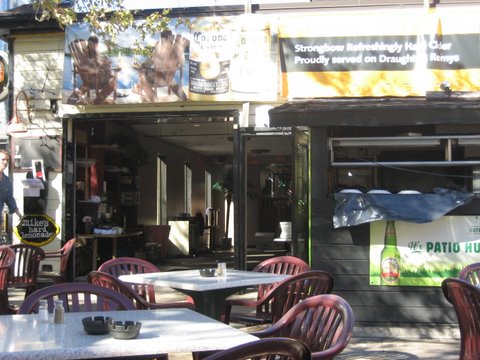
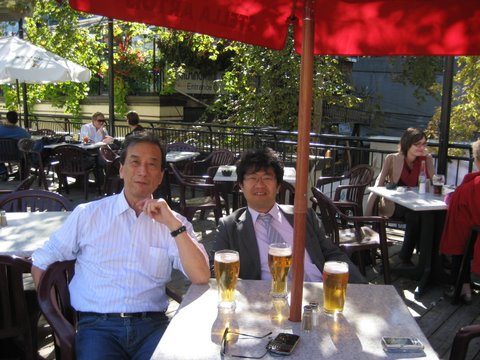
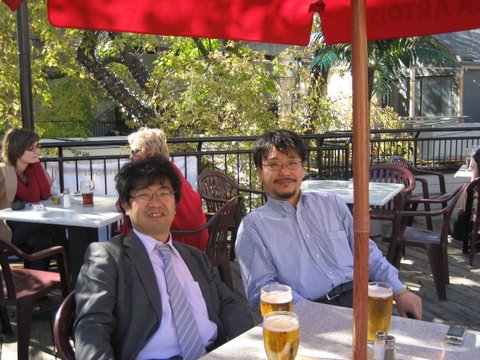
Welcoming Mr. Kohei Nishiyama at the Keio University Shonan Fujisawa Campus

→Japanese

This semester, I am conducting a course on ‘Innovation in Globalization’ at Keio University Shonan Fujisawa Campus. (Ref.1)

As I have previously reported here, I recently was traveling outside Japan for a duration of two weeks. Because of this, Dr. William Saito  and Mr. Kazuhiko Toyama (in Japanese) kindly helped me with my course and delivered exciting lectures to the class in my absence.  Just after the October 13th class, I called from Seattle and thanked them.

This week, on October 20th, my guest was Mr. Kohei Nishiyama of Elephant Design.  He delivered  a very stimulating lecture about his business and on how he founded such an innovative enterprise that incorporates unique global vision and processes.

If you are interested in hearing this lecture or another from previous weeks, all of the lectures from my class are online in Japanese. They have all been extremely informative and I recommend that you take time to watch them.
・ Dr. William Saito
・ Mr. Kazuhiko Toyama
・ Mr. Kohei Nishiyama

After class that day, I went to PASONA’s head office in Tokyo to give a lecture at the joint session by Osaka University Graduate School and PASONA Career Juku.  This was again a very exciting session.  Mr. Nanbu, the CEO of PASONA, is a wonderful business leader.  He designed a program to support young professionals find jobs by providing them opportunities to learn business skills through hands-on experience.  By providing such opportunities, Japanese youth gain invaluable knowledge about what they want to do in their professional life. It is important to participate in this sort of activity in anyway possible.

Supporting and encouraging Japanese youth to build their careers is crucial for the Nation to prosper.  Elders must never try to discourage youths from dreaming. The more repressed children and students are, the less chance there is of this portion of our population to reach their full potential. If a country is dominated by adults who only want to fit youth into a preconceived box, limiting opportunity and growth, then the future of the country will not be promising.

So I encourage you all to invest in our young people.

Boston Career Forum: Companies in Japan Recruit Japanese Bilingual Professionals

→Japanese

In Boston, on October 22-24 Japanese companies will hold a Job Fair to recruit bilingual (Japanese and English) young professionals. For 20 years this event has supported people dedicated to their goals, believing that where there is a need, there is a business.

Their invitation reads as follows;
? 130 companies and institutions will gather for 3 days from October 22nd (Fri) to 24th (Sun) to recruit university students, graduate school students, researchers, and professionals from all over the world.
? While we understand that many of you plan to remain in universities as researchers or faculties, many top companies in and outside of Japan gather here to offer variety of positions not only to new graduates but also to people in specialized fields, engineers, and researchers.
? This Forum is a great opportunity for those who consider working for private companies as part of their career.
? We have travel scholarship for participants who are traveling from long distance.  Please check the web site below for information and registration.
? It is a great pleasure for us to offer you variety of career information and opportunities.

The list of participating companies and information on travel scholarship are posted on the website.  Similar events are also held in London, Tokyo (Summer and Winter), and Los Angeles this year.

A little more about the event:

What have some of the outcomes of Job Forum been over the past 20 years?  How have the jobs been of the people who found opportunities through the event? Just recently I heard that even now, Japanese companies have had young non-Japanese professionals sit idle at their desks everyday from 9am to 5pm in order to “get them used to the Japanese business system” rather than utilizing their talents or qualifications.  This is hard to imagine but it happens.

Excluding Western companies, I am curious how these companies have treated people and whether those people have been held outside the standard “seniority-based promotion system”. Or, were these talented people subjected to those rules, where time spent in employment counts more than your performance?  I hope not!

I understand that it is a very difficult time now for students in Japan to find jobs.  People have different views on this issue, perhaps believing that education’s sole purpose should be to enter directly into the work force. But I think what we need now is to broaden basic awareness.  I wonder what Japanese companies expect of students. Ater they have made informal offers to students during their third year at university, how do they expect the students to spend rest of their college career?  Are they expecting them to start preparing for the new job?  Do they expect them to stop exploring their interests? I certainly hope not!

I hear that even at the University of Tokyo, the parents accompanying students to the graduate school education briefing demand explanations and methods on how their children should find employment after graduation. (in Japanese). What kind of society is this?  Both parents and students are lingering to other people’s support.  They are by no means independent, self supporting individuals.  Regarding this issue, I recommend reading the blog posting (in Japanese) by Professor Iiyoshi of MIT who specializes in education and authored ‘Learning by the Web (Web de Manabu).  We must recognize that the Japanese society of ‘life long employment and huge pensions” is quite over.

The media reports that the number of researchers studying abroad is also declining (in Japanese), (and I intend to analyze this on another occasion…).  In the meantime, I think it is a good option for young people today to go abroad for higher (graduate school) education and to pursue careers showcased in overseas recruitment seminars as I have introduced to you above.

The younger you are, the more potentials and options you have for your future.

‘Because This is the Time of Uncertain Future, Be More Courageous’ is my message to you.


GLOBE Live 2010

→Japanese

'GLOBE'  is an eight-page long special brochure created by the Asahi Shinbun, a widely distributed newspaper.  Twice a month on Monday mornings these stylish brochures appear and cover various topics of the world. As you have read in one of my posts on GLOBE (Ref.1, 2), I was invited to write some articles for them.

The title of my article was "Why University of Tokyo is Poor in Producing Nobel Laureates – Blame Goes to the Easy Going Conditions of the '4 Lines Professors' " (in Japanese) . The  term '4 lines professors' seemed to have been a catchy expression, and the editor received many comments from the readers.  However, my primary message was to 'Make the Best Use of Human Resource' – one of my core themes which I have been writing about repeatedly in my website.

Another nice thing about the 'GLOBE' is that everything is On-line. (in Japanese)

On Sunday, October 17th, I was invited to 'GLOBE LIVE 2010' (in Japanese) held in Tokyo to celebrate its 2nd anniversary (the 1st anniversary took place in Nishinomiya, the western part of Japan…).  The venue was packed with guests.

The programs were fantastic (in Japanese); the guests were interviewed, there was a performance on the piano by Mr. Takatsugu Muramatsu, (Ref.1 in Japanese) and during intermissions, songs were sung by Ms Miu Sakamoto.  The  interviews started with myself, followed by people such as Mr. Atsushi Ogata,  a multi talented film director 、Mr. Dai Fujikura (Ref.1), a composer, Mr. Steve Yamaguchi, (in Japanese), (Ref. 1 in Japanese), (Ref.2) , Ms. Sakie Akiyama (in Japanese),   (Ref.1 in Japanese), (Ref.2),  Mr. Hiroshi Watanabe  (I have introduced him to you as one of the '7 samurais') . It was a breathtaking list of talents of which I am humbled to have been included.  These people are all introduced in the GLOBE, so please see their web site.  The host of this event was Ms. Maki Nomura of Asahi Television (in Japanese) ,and editors of GLOBE, Asahi Newspaper.

Overall, the production was conducted nicely and with good tempo. I fully enjoyed this event.  Thank you to all who participated.

(I removed the sentence about the reception because it seemed “anti-climactic and to derail attention from the event itself)

Below are some of the blogs commenting on this event.

http://legendokiki001.at.webry.info/201010/article_1.html 
http://changemylife.blog.so-net.ne.jp/2010-10-17 

It would be great to have English version On-line report on 'GLOBE LIVE 2010' .  I am looking forward to seeing it.


Another Visit to Toronto in Autumn, A Meeting with Munk School on Our Collaborative Project

→Japanese

I have been visiting Toronto twice a year, in Spring and Autumn for the past two years (Ref.1,2,3,4,5). 

This time, I left Singapore early in the morning of 7th, spent 2 hours each for transit at Narita and Chicago O’Hare airport, arriving at Toronto at 7pm.  By coincidence, I came across President Hatta and Vice President Fukushima of GRIPS, where I currently work for, at the Hotel check-in.  After taking a short rest, we went for dinner at the near by Italian restaurant Fieramosca.  Actually the place was quite nice.

Next day was a perfect autumn day, without a single cloud in the sky.  Dr. Sunami,  of GRIPS, myself, Dean and our partner at Munk School of Global Affairs (Ref.1), graduate students, and other interested people, total of 10 or so gathered to finalizing our plans for our collaborative Project.  This Project is about ‘Integrated Innovation’ in global poverty and development, to investigate the current status and craft practical policy recommendations.  We have been working on this for some time and this meeting in effect finalized the basic outlines for grant application.  I am very pleased for our progress.  By the way, we also plan to invite interested and committed researchers in this project, too.

While the meeting was still going on, I left the room to visit President Naylor at his office, to join Drs. Hatta and Fukushima, who were visiting him as part of their effort to set up exchange programs with several universities in Canada and GRIPS, and we discussed various subjects including possible future exchanges between GRIPS and University of Toronto. University of Toronto is very positive about encouraging international exchanges.  In Japan, on the contrary, not many students today are interested in seeking overseas study and expreiences, and this problem is becoming a hot topic in Japan recently (Ref.1), which is a huge difference compared to Canada, a quite a cosmopolitan naton.  But I think, in Japan, it is not the young generation that are reluctant to leave home, but the grown ups around those young people.  This will naturally make young people while they grow, lose interest in the outside world.

I enjoyed nice time over lunch at the faculty club dining room located in the building beautifully decorated with wild vines.  The huge campus is surrounded by trees and greens, it is clear at a glance that the students come from quite diversified backgrounds.  Everyone looks lively and cheerful.  Since it was the Thanksgiving season in Canada (one month earlier than U.S.), there seemed to be fewer students around, though…. I spent rest of the day taking a walk through the charming small paths behind the Four Seasons Hotel, visiting Japan Foundation Office in Toronto, having dinner together at the local Chinese restaurant.

Next morning started with a breakfast with Dr. John Dirks, the Chair of Gairdner Foundation Selection Committee, followed by a visit to Royal Ontario Museum to see Terracotta Army, and meeting with several other people. It was a wonderful 2 days in Toronto blessed with beautiful autumn weather.  I will leave for Seattle on 10th.  Toronto is a very Cosmopolitan city.

Although I saw fewer students than usual in the broad campus of the University of Toronto, probably due to the long weekend, I couldn’t help but feel that young people in Japan, or Japanese society as a whole in that sense, are currently in low spirit.  It is fun to go abroad at young age, while you are more capable of being sensitive with a variety of things, having broader career choices ahead of you.  I know that Japanese youths who participated at the Asian Youth Exchange Program in Okinawa (link to the AYEPO report of this year) got the idea of how other youths in Asia think and act, what and how they study.  They continue to keep in touch with each other.  They will make friends with young people around the world, and gradually will be able to find what they are good at or what they want to do.  Human network will expand from such experience and maybe the possible field of their future activities, too.  So, as I always say, I recommend you all, no matter whether you are in high school or university, to ‘take a leave of absence from school’ ? and there would be variety of styles to choose, for instance, what you do, where you go, or how long you stay.  I am pretty sure that you will have some eye-opening experience, and find something that you would really like to do.


From Singapore

→Japanese

Click here for photos of Marina Bay Sands Resort

I left STS Forum in Kyoto early in the morning of October 5th, made a brief stop at my home, and arrived at GRIPS early in the afternoon.  There, I had a good conversation over various topics with Dr. Han Seung-Soon, the former prime minister of Korea, whom I have met in Seoul just recently.  Then, I took a train from Tokyo Station to Narita Airport, arriving at Singapore at around midnight.

IMG_0008 (2)

Next morning was a board meeting of A*STAR . The discussion was heated from beginning to the end until the meeting closed after lunch.  This board is working quite vibrantly actually.  Budgets are allocated to make Singapore more competitive in science, technology and research, to build new opportunities ? very constructive and active.  A*STAR is also planning a collaboration with Universities in Iran, in order to develop further exchanges of talented students.  Another project is the Liberal Arts course that has a full boarding system which will be offered in collaboration with Yale University.  In short, they are so dedicated to nurturing global talents.  It is a common sense, so to say, that ‘Nurturing Human Talents is the Base of Building of a Nation’ (in Japanese), but it seems quite different in a country who knows where. The problem is that adults, the grown-ups, are ‘closed minded’, and that will make it difficult for our nation to address problems we are expected to face in this rapidly ‘flattening age of globalization’.

Late in the afternoon, we visited the ‘Marina Bay Sands Hotel and Resort’.  First thing to do was to see the fantastic view from the top of the building, looking down the course of F1 autorace track that took place just recently, Marina Barrage  where I had been not so long ago, and right beyond the ocean lies Malaysia and Indonesia so closely.  The premise is a combination of three 57 stories high buildings, with hotel, condo, major convention facility, casino, etc. and a 150 meters swimming pool on the top of the building. The view is just breathtaking.  Elevators moves up and down in high speed ?very fast- but motions are almost unnoticeable.

Its grand scale, however, is not the only thing that impresses us.  Prices are also soaring high; Hotel, Condo (still some vacancy…), Casino (sheer admission cost 85 dollars), and practically anything.  After the tour, I had a nice cheerful dinner with other members of the board.

I recommend that you visit this Sands Hotel and Resort if you have an opportunity.

After returning to the Hotel, I spent about 2 hours with Professor Ito, who has been working vibrantly at Singapore for about 10 years, Professor Yamamoto, new member of NUS faculty, and Dr. Steve Chu, a member of the board of UCLA.  I have known Professor Ito since he was at Kyoto University, but he moved to Singapore after retirement from Kyoto, and was awarded President’s Science Award this year.   I congratulate him for this great achievement.  We are so proud of him.

Why don’t more professors of Japanese universities broaden their world and go out to spread their field of activities instead of sticking around universities even after their retirement, I wonder?  Recently, it seems that many accomplished professors stay at universities taking advantage of their uiversities being Independent Administrative Institutionization (Dokuritsu Hojinn).  This would cause less room availabilities, and I feel sorry for young people.  Yet, more ‘adults’ and ‘professors’ complain that youths today are not passionate about going abroad.  This is a problem.  Mind you, young people are quite aware that their seniors are not being consistent in their words and actions.

Tomorrow, a car will pick me up at 5:15 am to take me to the airport.  I will fly for Toronto from here.


Participating in Variety of Projects, and Once Again, About Armchair Quarterback

→Japanese

On September 28th and 29th, Asia Innovation Forum, as you have read in my website last year, was held again.  It is its fourth year and several small ‘satellites’ were set up.  The sizes of the rooms were smaller, in fact that contributed to making the discussions to be more engaging and participatory, and people seemed to like them.

I joined in the last two panels on the 2nd day (in Japanese).  Panelists in the first panel (in Japanese), besides myself, were Dr. Ishikura and Ms. Ishiguro whom I worked with a week ago at the ‘Marunouchi Career Juku’, as I have reported recently, and with Ms. Kaori Sasaki and Ms. Magsaysay Chou, a business leader from the Philippines.  Here, I was again the only male panelist as was the case at the ‘Juku’ last week.  However, this time, the audience consisted mostly of middle aged or senior men and I somehow could feel the difference clearly from a week ago as I participated in the discussions.

The latter panel was hosted by the same host as last year, Mr. Kusunoki, welcoming Mr. Idei (former CEO of Sony) of Quantum Leap, the organizer of this Forum.  I stayed rather quiet this year.  Many views were presented to answer the question ‘One Thing That Would Bring Changes to Japan’, and many panelist pointed more than one Thing; but I had nothing else to say besides ‘Recommendation to Take Leave of Absence from School’, that would give youths broader choices for their future career.  Traditional system of Japan Inc failed to change for more than 20 years even after the burst of bubble economy in 1990, because of the strong opposing power of the establishments. Whatever things that are said have been said many times in the past, but nothing changed as of today.  I sincerely wish to give hope to youths who have long future ahead of them.  To my regret we have seen hardly any changes during these 10 to 20 years, regardless of many policy recommendations made in terms of legislation or budgets.  What matters is ‘execution of plans’!  I think this problem has become basically ‘a battle between generations’, ie, ‘the past vs the future’ generations.

We may need to think differently when we plan our next Forum.  Since Mr. Idei is a wonderful leader in the business sector, together with him, let us craft plans with even stronger impacts for the next year.

On October 2nd, I joined in the ‘Global Agenda Seminar’ (in Japanese) (Ref.1), hosted by Dr. Yoko Ishikura.  Our guest was Dr. Kano, who now works at the World Bank in Washington DC – such youth like him working in global arena has power to easily connect with the hearts of young people who join this very interesting Seminar.

After the Seminar, I headed for Kyoto in the afternoon of October 2nd to participate in the STS Forum.  This Forum gathers so many leaders from all parts of the world, so I enjoy seeing many friends as well as their interesting panels.

Reports will be uploaded on the web sites of each event, so please keep eyes on them.

My schedule is quite tight, I have to admit, but on the other hand I am also concerned about how slow Japan is in its changing.  I think the Democrat Party administration has to face numerous difficulties lying ahead of them.  They are not yet experienced enough in handling the process of politics and legislative processes.  Will it take another 1 to 2 years for them to work effectively?  Also, it is not good that each minister comment on recent China- Japan problems separately and not consistently as one Cabinet.  Diplomacy must have a good, stable leadership in the government.  Even if the ministers think they are speaking to Japanese only, their comments will quickly be translated and be sent out to the people of the world, in particular, to the governments of nations which are interested in Japan affairs.  Current style of press coverage of these Ministers will serve only to give impression that Japanese government has no governance.

I have once written about the effect of ‘Armchair Quarterback (Okame Hachimoku)’  (in Japanese) in my web site, and in that sense, the mail magazines (in Japanese) and twitter (in Japanese) by Mr. So Bunshu are very thought provocative.  Mr. So has deep knowledge about the way people think and feel both in China and Japan, reflecting his own background and real experiences in both countries.


‘Global Science and Innovation’ Course Starts at Keio Gijuku University Shonan Fujisawa Campus (SFC)

→Japanese

At this year’s entrance ceremony of Shonan Fujisawa Campus (SFC), one of the most prestigous universities of Japan, Keio University, I had a rare opportunity to deliver a special welcome lecture  to the newly enrolled students. SFC is a relatively new campus among the Keio Gijuku founded 152 years ago, just celebrated its 20th anniversary this year, well known and attracting new type of talents for its new concept.  

Numerous graduates pursue their own professional career in various settings within and out of Japan. And quite a large percentage of these alumni have careers quite distinct from the traditional Japanese common sense (however their careers may not be uncommon careers outside of Japan….).  I know many OBs and OGs of SFC personally and there are several whom I work with today.  

Perhaps from such reasons, I was asked to offer a course on ‘Global Science and Innovation’ for this fall semester.

The first day of the course was on September 29th.  This day was so to say an ‘Introduction of the faculty (Kaomise)’, so all students who may be interested in taking this course came.  They will decide in a week or so whether or not they would register.  A graduate student TA and an undergraduate student SA are assigned to support me.  Keio SFC posted my lecture very fast on their website already.  

Using such web as a ‘tool’, through ‘trial and error’, I plan to make it a fun, interconnected, open class in which all students participate.  Time is changing steadily but rapidly, as described in a recent book which I have already introduced to my students ‘Learning on Web (Web ni Manabu)’ .  

The students in my class are undergraduates from year 1 to 4, which mean that more than half of the students were born after 1989, the year of the fall of the Berlin Wall, Tiananmen Square protests in Beijing, and one year before the burst of bubble economy in Japan when the Nikkei Stock Average marked the highest share of 39 thousand yen.  Japanese economy has not grown ever since these students were in kinder garden.  I think parents, considering their age, should think about the domestic/international situation of the time in which their children grew up.  They were in primary schools at the time of ‘September 11’.  

Quite many of the students have had the experience of living abroad, I understand, so I think this will be fun.  How many students will register to my course, I wonder?  Being evaluated by students is somewhat like ‘budget-cutting panel (Jigyo-Shiwake)’, being evaluated by politicians of DPJ.  This is the hard and challenging part for the teachers in the ‘Open Education’, ‘Education in the Web age’.  

I intend to make this course a very innovative one together with the students as well as variety of guests which I am planning to invite.

Mr. Jun Kurihara of Harvard Kennedy School

→Japanese

I have introduced to you for a couple of times in my blog postings Mr. Jun Kurihara, Senior Fellow at Harvard Kennedy School (Ref.1).

He is also a research director of The Canon Institute for Global Studies , hops around the world, and issues ‘The Cambridge Gazette’ in nearly monthly bases.  As you have read in my previous posting about him,  this Gazette is quite good in a sense that you can intuitively sense his broad human network as well as his intellects.

Mr. Kurihara dropped by at my office when he visited Tokyo recently and we had a good time together.  I felt honored to find his comments on our meeting in his latest issue of ‘The Cambridge Gazette’.  As always, this Gazzette is also filled with evidence of his deep knowledge and broad human network.

‘A person like myself would be difficult to be accepted in Japanese institutions.  I think that is why things are like this…’ says Mr. Kurihara, but clearly he is a very valuable asset.  I am sure that if we had more of people like him in Japan this nation would be more lively and active.  If ‘Unique human capital’, ‘Nails that stick out (Deru kui)’ are given more and more places to flourish, organizations will gain energy and youths will have good ‘Role models’ which eventually will make them more positive and active. For organizations, it is important to give right person the right place so as to optimize the talents giving them more chances to flourish.

Domestic and international broad connection based on ‘credibility as individual’, like Mr. Kurihara’s, is a huge asset.  The Canon Institute for Global Studies chose a good member.  Without doubt Mr. Kurihara is one of our precious ‘Human capital’ (similar but not the same as the ‘Human resource’) whom no one can exchange with any amount of money.

From ‘Healthcare System’ Reform to ‘Health and Healthcare System’ Reform: My Basic Idea

→Japanese

Healthcare system reform is a huge political issue not only in developed countries but also in emerging or developing countries and in global society.  This is because of the rapid changes taking place in the structure of major diseases based not only on the progress of healthcare technologies but also on the enhancement of life expectancy, changes in social structure and in lifestyle.

In addition many societies share the problem of aging population.  Since public funding for healthcare expenditure is already pretty much to its limit even in developed countries this is another big challenge.  Also it is clear that income inequality within and across the countries continue to expand in this global world.

So, Japan is not the only nation that faces problems related to healthcare.  However, there are some reasons particular to Japan that make system reforms particularly difficult here.

This is one of the main themes that we work on at the Health Policy Institute, Japan.

However, in view of such major changes in our society, it is clear that healthcare system must be structured with more attention to social aspects.  In other words, we must take into consideration ‘Social Determinants of Health’ (Ref.1) in our policy, thus we must create not ‘Healthcare (Medical, in principle) System’ as it is but rather ‘Health and Healthcare System’. Otherwise I suspect that winning public support for policy or its implementation would be difficult.

Here, I will introduce to you my recent interview (in Japanese) reflecting such thoughts.

Same perspective is also expressed in my book ‘University Hospital Reform (Daigaku Byoin Kaikaku)’ (in Japanese).

‘Learning on Web: Open Education and Revolution of Learning’, A ‘Must’ Book

→Japanese

Dr. Iiyoshi  whom I have introduced to you last year (blog, Ref.1) (in Japanese) and Mr. Umeda  blog) (in Japanese) who is sending out messages from Silicon Valley such as his book ‘Going Through the Web Age (Web Jidai Wo Yuku)’ (by the way, he is also a great writer on shogi game (Japanese chess game))recently co-authored and published ‘Learning on Web (‘Web de Manabu)’ (in Japanese). The book offers lots of ‘eye-opening’ information, very rich in content, and I recommend strongly to all educators and people who are interested in learning or (their) children’s education.

‘Learning on Web’ gives you the idea and sense of how education, starting with the epoc-making OpenCourseWare of MIT (included in the Top50 websites in recent Times magazine), has become ‘Open’, how amazing the speed and power of the trend of the ‘Web age’ is.

As I have been pointing out repeatedly even in many public ‘occasions’  (Ref.1, 2), Internet is a tool that ‘empowers individuals’ with an impact comparable to the printing technology invented by Gutenberg in the 15th century.  Internet enables individuals in broader area to access and/or ‘share’ to broader audience.  It expands globally regardless of country border or time.  Conseqently, new ‘inquiries’ will be raised by many more people, ‘questioning of the (traditional) authorities’ will follow.  Thus, this change continues to move forward but never backwards.  Nations, companies, institutions which fail to adapt itself to this change, or attempts to oppose it will inevitably have to suffer more damages.  I regard this as the essence of ‘globalization’.

iTune, iPod, IPhone, and iPad are some good recent examples.  Just by thinking what industrial sectors resisted, or how these products changed society or the global world, and what eventually became of those resisting power, you will well understand what I mean.
  
In other words, this ‘Learning on Web’ is not only giving information on the new world changes of education to educators, but also reminding them of their responsibilities and questioning how they performed.

However, if you see this book as ‘empowerment of individuals’, ‘Learning on Web’ is asking actively to all students (recipients of education) and learners (who are willing to learn) what kind of education they want, introducing them to new educational opportunities and tools for learning, possibilities of discoveries that make them better and grow.

Also, I sense in this book a concern for Japan which appears to be resting in isolation from the change of the world.  I imagine that this is because that the two authors have been away from Japan for long years, have built their careers outside Japan as an indepedent individual, and therefore are increasingly becoming frustrated and even sorry  (in Japanese) for closed Japan which remains incapable of changing in this rapidly globalizing world, and also reflect their deep love, ‘patriotism’ (not ‘nationalism’) for Japan.

I recommend this book to all people, a ‘must’ reading to all grown ups who are concerned with education.

By the way, the outline of this book and the points they intended to make are given in the blogs of Mr. Umeda and Dr. Iiyoshi  which I have introduced to you above.  Many of the resource sites introduced in this book are shown in a list in this blog. Even if you do not have the book ‘Learning on Web’ at hand, these blogs will help you visit many valuable sites.

It is wonderful to know that there are so many, many people who are devoted to education and nurturing people of the ‘world’.


?