The Economist, Sarcastic But Honest: ‘Food For ‘Zombies’, ‘The Civil Service Serves Itself’

→Japanese

I would say that ‘The Economist’ competes for the 1st or 2nd position as the most widely read weekly magazines in economy.  This magazine even picks up the issues of its home country, Great Britain with plenty of sarcasms, to report to its people and the world what they need to know.  This precisely is the most important and basic mission of journalism, the foundation for its credibility.  The Economist has its own ‘unique, cool’ style in writings, titles, figures and charts which makes it so special and unsurpassable.

Those, I think, are the reasons why The Economist or Financial Times are so highly evaluated, being read by business people throughout the world.  In short, their works are professional.

Japanese journalism is quite different here.  Basically it is rather on the establishment side as you see for example by the system of members only ‘Press Club (Kishya Kurabu)’ and their reports are in large part targeted to Japanese only, i.e. mere 2% of the population of the whole world.  It is a matter of course then that journalism of the ‘global age’ will not develop in such circumstance. I doubt that they (Japanese journalists) have such ambition to be global in the first place.

I have recently introduced to you in my blog one of the articles of The Economist and here I would like to call your attention to a good sarcasm in the article (1) and another in the ‘On-line’ edition (2).

Please refer to the original for the full text but:
In (1), the subtitle is striking; ‘Food for zombies’(click here for Japanese translation of the article). They write how Japanese government endlessly supports not well performing big companies, and new enterprises hardly emerging, so many no-good companies survive, thus only to become ‘zombies’. This is a keen observation which I totally agree.
In (2), the title is; ‘The civil service serves itself’ describing the irresponsible current mechanism and governance of Japanese bureaucrats or civil servants; they enjoy ‘Descent from Heaven (Amakudari).’ Spending huge amounts of public money for themselves.

The world is noticing the reality of Japan.  What will become of our national credibility?

These days politics seems to be occupied with nothing but their struggles within the party.  Our country is having 5 prime ministers in 4 years – an outrageous nation (Tondemo Kokka) – are we going to have the 6th prime minister beginning later this month?

What has become of the elites of ‘intellect’ of this nation (Ref.1); ‘legislators, governments, industries’ and ‘academics’, I wonder?

Don’t they care any more about the people of Japan?
Does Japan now have to head for the crises ?

Hayman Island, ADC Leadership Retreat -1

→Japanese

Please click here for the photos.

After attending two conferences from the morning on August 27th, I returned home to pack my baggage and be at Narita late in the afternoon.  This was the reason why I was unable to attend the lecture of Professor Sandel.

The plane took off from Narita shortly after 9pm arriving at Brisbane Airport at 7am after a 9 hours’ flight.  The cabin was not too spacious although I was in the business class, the seats did not become near-flat, so I did not get much sleep.  At Brisbane airport I spent 4 hours for transit to JQ (JetStar) for an 1hour and 40 min. flight to Hamilton.  Then finally I got on a cruiser to Hayman Island. At last I am here to join the  ‘ADC Forum Retreat’.  Regretfully I have been unable to accept their kind invitation for a few years because of my schedule elsewhere.

Most of the people on the cruiser were those who came for the meeting.  Inside the cruiser was very comfortable, cruising moved smoothly on the quiet surface of the sea, we enjoyed the nice view of many islands that the boat passed by.  A whale was seen along.  We were told that we were cruising along the route of the whales.  The weather was not too wonderful but was not too cold either.  I think it was about 70?.  A bit cloudy, rain might be falling any minute.

As we were enjoying glasses of champagne and conversation for about an hour, the boat arrived at the Hayman Island.  We wasted no time to check in to the hotel and were guided to our rooms by 4pm.  It took quite a while for my baggage to be delivered to my room, however.

The time flew quickly and the ‘ADC Form’ (Ref.1) started at 4:45 pm.  Since I was scheduled to be on ‘Opening Plenary: Australia ?Big questions and new unknowns’ I had no choice but to go to the venue and on the stage in my jeans (to my relief everybody was dressed casually, no one had ties on…)

The federal election of 6 days ago resulted in both Liberal/National coalition (Mr Abbott) and Labor (Ms Gillard) parties gaining less than half of the seats by a few seats, both now starting to negotiate with the minority parties for cooperation.  Such phenomenon (is called ‘Hung Parliament’, maybe the same as the ‘Twisted Parliament (Nejire Kokkai)’ in Japan) was never experienced in this country in the past.  So the argument follows that this might be the end of the ‘Era of 2 Major Parties’.  The same thing happened at the General Election in Great Britain, remember?  Maybe this shows how values of the people are changing and diversifying in this global age beyond just two parties to choose.

The Opening Panel was hosted by the well known anchor person of BBC, Nik Gowing , Part-1 started with a 15 minutes’ comments on the federal election by Ms Annabel Crabb, the chief political writer of ‘ABC Online’, followed by the vibrant discussions by 3 Panelists.

Part-2 started by a 20 minutes’ speech by ‘Lord Nicholas Stern’ on Climate Change and (its) challenge for economic growth, reflecting analyses of economic growth cycle led by technology innovation, each lasting 50-60 years after the industrial revolution; with changes in social structure and function.  Then followed a panel by Dr Raghida Dergham, a columnist and a reporter on diplomacy, Bror Saxburg, Chief Learning Officer of Kaplan, Dr. Daniel Shapiro of Harvard University and myself.

Both discussions at ‘Part 1’ and ‘Part 2’ were extraordinarily interesting and stimulating.

The federal election in Australia is one thing, but on the other hand, in Japan, there were 5 prime ministers in 4 years after Mr Koizumi, and just a week ago Mr. Ozawa announced that he will run for the head, thus for the prime minister, in the Democratic Party of Japan which means that we might have 6 prime ministers in 4 years.  In Australia, the latest election result raised a big political discussion.  How about Japan?  Aren’t we too optimistic, too easy going, not analytical on agendas of canditates, and implications?  Anyhow the way of thinking and behavior of our ‘leaders’ are ‘in the teacup’ mode – just too much.  Good grief….  Nor do I recall hearing any sort of ‘national vision and strategic policies for the issues’ from any of those leading legislators to begin with.

At dinner, I was seated next to Lord Stern so was able to have a very good intensive discussion with him.  This was a great bonus for me.  Actually, I missed chance to see him in Tokyo for 2 times in these two years.  This was a part of our conversation, too.

After dinner, the final session ‘Science, Public Policy and the Elusive Common Ground’ started at 10pm.  I was one of the 2 panelists with Prof Penny Sackett, the ‘Chief Scientist for Australia’ for the Australian government.  This 1 hour session was hosted by CSIRO’s CEO, Dr Megan Clark.

The whole day was full of learning and pleasure.


L’Oreal Women in Science Fellowship, Astronaut Naoko Yamazaki Wins Special Award

→Japanese

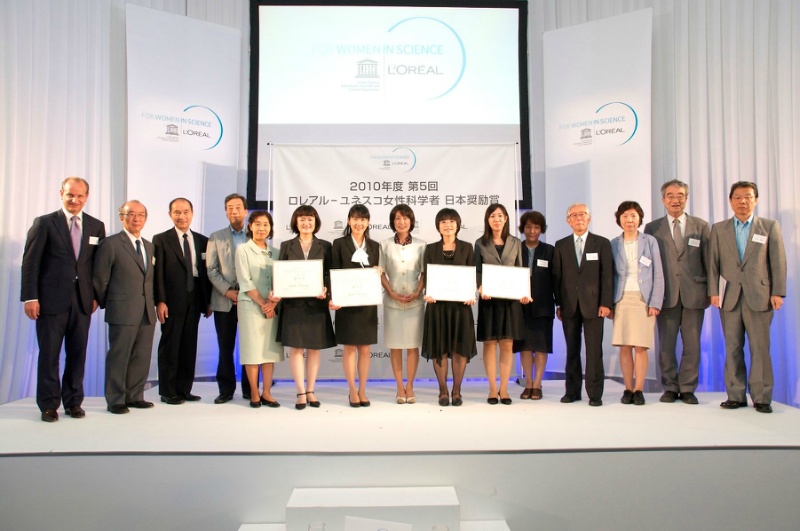
On August 23th I left Okinawa AYEPO 2010 closing ceremony for Tokyo where I headed directly to the L’Oreal Women in Science Fellowship Award Ceremony.

As I always say, shining women are the hope of Japan.

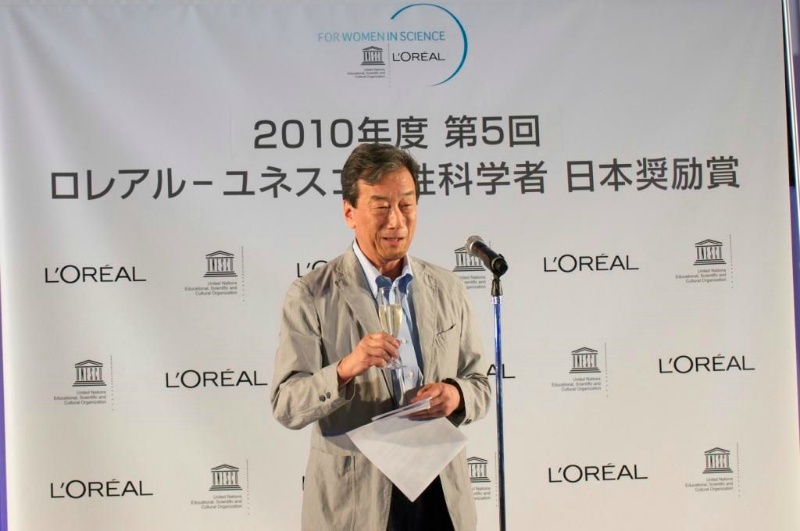
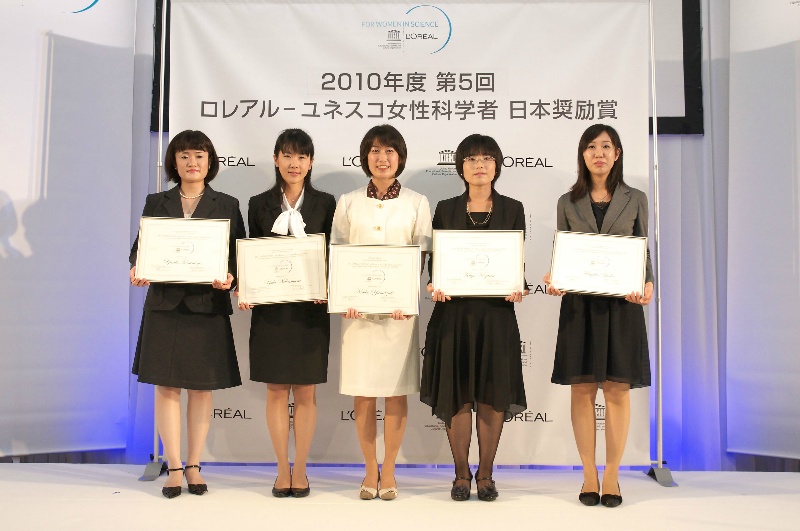
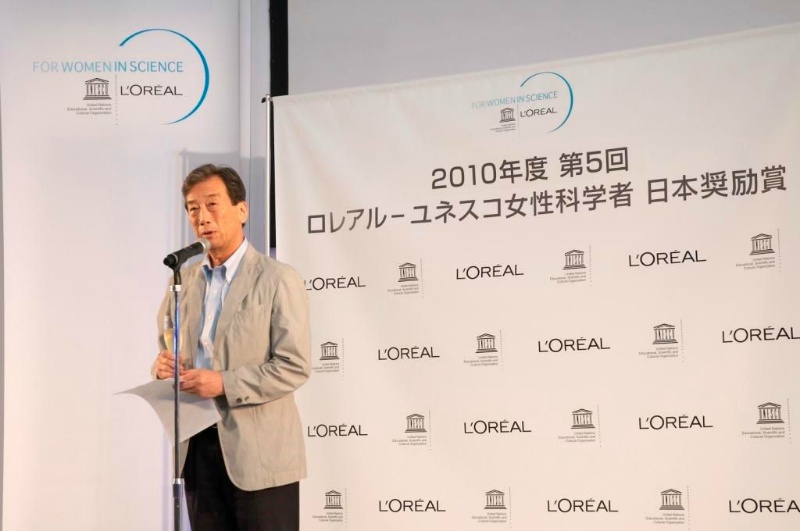
Again this year 4 bright and young women scientists were awarded this honor.? Also this year, a special award was given to astronaut Naoko Yamazaki? (Ref.1). The ceremony was even more highlighted by her presence.? The stage was very beautifully set up and the program moved smoothly, which is very much the ‘L’Oreal style’, as I always say.? I was asked to make a toast, which I of course happily accepted.?

Every year beginning 1998, in collaboration of UNESCO, 5 wonderful women scientists are awarded one each from the 5 continents of the world?(Ref.1). This fellowship award, by the way, started in Japan five years ago to encourage the young women scientists.

I spent wonderful time with wonderful people just as I did two year ago at the award ceremony of 2008.

Quite a number of people gathered include Mr. Koichiro Matsuura, former Director General of UNESCO, former (Ms Bando) and current (Ms. Okajima) Directors of the Gender Equality Bureau, Cabinet Office (3 successive directors since this post was founded are all women).

The future of Japan lies in how quickly we can create and expand the places for women to participate actively?(Ref.1,2).?

I would say that the major barrier is the ‘men-centered chauvinistic’ mindset and social structure, the society? where ‘herbivorous (soshokukei) men’ are dominating and taking charge.? I also suspect they (men) are scared of revealing how they actually are.? However, it is clear that in this transition from ‘vertically’ to ‘horizontally’ expanding global age, the time of ‘social titles’ with little real content or value to the world has ended long time ago.

?

China Ranks 2nd, Japan Goes Down to the 3rd in the World in GDP; From the Article of The Economist

→Japanese

GDP of Japan which used to be the 2nd largest in the world fell to 3rd after China.

This news itself is not so much to worry about because GDP is strongly affected by the size of the population. China with population 10 times larger than Japan to overtake her (Japan’s) position of the 2nd in the world ranking of the GDP was something that was predicted for a long time the only question being ‘when’.

What truly matters is the GDP per capita.  Japan has fallen off the position of the 2nd in GDP per capita the world and has keeping places somewhere around 18th or so for quite a while.  This is not surprising, since, to begin with, Japan’s GDP has not grown in the least for these 15 years.  I suspect that Japan is the only nation in the OECD (in Japanese) that has not achieved any growth in GDP for these 15 years.

Up to date no signs of growth are observed in Japan, and few in the world expects little sign of change from Japan, thus no investments come to Japan.  Changes in other OECD nations are obvious since the 2008 ‘Lehman Shock’ but Japan is still lingering in that terrible situation of ‘no economic growth, increasing its dept only.’ 

The Economist, as always, is pointing out the important issues clearly in its article of August 19th ‘Watching China whizz by’ (Click here for Japanese translation of the article). Views of Professor Ishikura, one of my friends, appear in the article, too.  As I say, larger corporations can not make decisions or is late when they do.  As the article points out, big companies are basically all the same in their conducts, our government does not dare to let incompetent companies down so it makes many ‘Zombie companies’ surviving.  This will discourage new enterprises to emerge.  Don’t they realize that the market and business of the world has changed drastically?   We are now in the age of ‘Demand-driven、Open and Disruptive Innovation.’

Anyway, as you see in the chart in The Economist the rate of growth of economy in China is extraordinary.

Not knowing your partners, not having multitudes of networks of friends of long time in growing developing nations can constitute big handicaps for our future growth.  Just to give you an idea, for example, the estimated growth rate of the whole Africa is 5.6%.  What are your business strategies?

Out to the Expanding Blog Network of the World

→Japanese

Basically, I write my Blog postings in both Japanese and English.  Without English, this Blog would belong to only 2% of the people in the world and although my main target is the Japanese people, I believe that many of my messages have relevance to the world, and to Japan..

Sometimes I receive comments from overseas.

Among them was a recent e-mail inviting me to link to one Blog.  I imagine that this could be partly because postings from Japan are not many.  Understanding that their site is well known, I was happy to accept this invitation.  They seem to choose which of my postings they will link to their site, a good thing.

This is my site in their Blog.  How much increase in hits will this link bring?  I look forward to finding it out.


Activating Intellectual Property of BioScience and Tech in Universities; Can We Succeed?

→Japanese

Although countless problems are still to be solved, attempts to make use of intellectual properties accumulated in university and research institutions will get started.  This is good.  This is an effort to build functional structures that are attractive to enterprises.  There are still, however, many problems and challenges along the way enough to cause you a headache…..

I joined the press conference (in Japanese) in August 6th with my colleagues.

Scientists, engineers tend to draw a big picture or expectations from their own findings or inventions, thinking and sensing somewhat in a linear, direct goals.  It is only natural that they do so and there is nothing wrong about it.

However, people who are not scientists or engineers would often think about these findings or outcomes in relations to other ‘idea/information’ and sometimes better ‘idea/information’ emerge from such thinking.  In Japanese, we express this phenomenon as; ‘Okame Hachimoku (Onlookers can read the game (far) better than the players themselves)’ (in Japanese).  Many examples of Okame Hachimoku are found in history.

After all, it is private sector and enterprizes which deliver new services and products from inventions and discoveries to customers, thus create new market. Scientists or engineers can not do this. Of course, there are always exceptional scientists and engineers who also succeed in business, but they are exceptions. 

The new combination – ‘Neues Kombinazion’ as Schumpeter put it - is precisely what creates new values.  This is precisely the ‘innovation’ that Schumpeter talks about.

Clayton Christensen, as you know, is today’s guru of Innovation.  Especially, ‘Disruptive Innovation’ is the core of his outstanding research.  His analysis, insights, views…everything in his books are extraordinary.  More recently, he writes on education and health care, too.

I think many businessmen read ‘The Innovator’s Dillemma’, another well known book, a bit older, but a classics, published about 10 years ago.

NHK TV Broadcast: Global Health- Chatham House

→Japanese

Recently I have posted a report on ‘From G8 to G20’ meeting on Global Health- Chatham House、London.

I also reported that NHK television crew joined us to cover this meeting.

The NHK made two sets of 30 minutes English programs ‘Asian Voices: Global Health’ based on interviews with the main participants of this meeting.

Dr. Shigeru Omi, former WHO member appears as a guest commentator in ‘Part 1’ and I appear in ‘Part 2’, both hosted by Ms Aiko Doden, who speaks very nice English.

This program will be broadcasted on Cable TV at overseas, but in Japan and elsewhere will appear On-line for several times.

Please check the Cable TV and On-line broadcast schedulein Japanese) of ‘Part 1 and Part 2’.

‘Part 1’ comes in 6 series starting from 11:10 am, August 7th (Sat) through 7:10 am, August 8th (Sun).

‘Part 2’ consists of 5 series starting from 11:10 am, August 14th (Sat) through early morning; 5:10 am, August 15th (Sun).

I was actually a little nervous when the interview was done without any rehearsals so I imagine that there must be several places here and there that make me blush if I see the video clips (though I haven’t seen it, yet).  But after all, in the Global age, what matters in “English is ‘the content’, ‘to speak’ and not in the least ‘pronunciation’”.

I invite you all to see this program.

Japan Wine Challenge Gala Dinner & Charity Auction

→Japanese

I enjoy wines, not as any expert, in contrast to many of you and friends, thus have posted a few times such occasions when they are exceptional. There are also many gatherings for fund-raising charity I join sometimes with my friends.

Last week, I joined with my good friends, Japan Wine Challenge Gala Dinner & Charity Auction; this year’s charity is for the Tyler Foundation, which has been active in helping children with cancer.

I am not an expert of wine, but enjoy good wines as I posted a few times (Ref.1).

We joined around a table with 10 friends, and one wine expert to guide us. It so happens he knows well not only about wines, but also a very good friend of a couple who owns a wineyard in Baune, Bourgogne, where we stayed for three days in March.

Many surprises, old and new friends, and lots of fun conversations over many bottles of wines and a course dinner. Total money raised through auctions and lotteries came around 10,000,000 Yen, which goes to the Tylor Foundation..

We all had a good time. 

A Very Provocative Dialogue with Mr. Kazuhiko Toyama

→Japanese

Among the books that I recommend to young people are the books by Mr. Kazuhiko Toyama (Ref.1) (links are in Japanese), ‘Yubi ippon no syunen ga shyobu wo kimeru (A finger-tip of obsession decides the winner)’ and  ‘Kaishya wa atama kara kusaru (A company will rot from the head)’.  If you have not read these books yet, I can assure you that they are worth reading.  Mr. Toyama has done a great job at Sangyo Saisei Kiko (Industrial Revitalization Corporation of Japan) and more recently was involved actively in the effort of revitalizing JAL (Japan Air Line)

Three years ago, Mr. Toyama and his colleagues established International Growth Platform and I was invited to its 3rd Anniversary on July 8th.  At preliminary discussions we decided that we should make very provocative comments.

The program opened by a dialogue between Mr. Toyama and Professor Kunio Ito of Hitotsubashi University (in Japanese), followed by a keynote speech by Mr. Hasegawa (Ref.1,2) (links are in Japanese), President and CEO of Takeda Pharmaceutical Company Ltd., and the last was a dialogue between Mr. Toyama and myself.  Audience was about 200 people.  I arrived at the venue late so I missed the dialogue session of Mr. Toyama and Professor Ito.

President Hasegawa is a very sharp and able business executive, always speaks up his real views without hesitation and ‘no no-sense’, demonstrates strong leadership in carrying out what he believes is right.  He also earns high reputation at the Davos meeting as a top business leader.  Mr. Toyama and I, standing on the stage throughout the session, exchanged challenging and very provocative views to endorse and enhance the messages delivered by Mr. Hasegawa – his (as always) sharp analysis and drastic points of view reflecting his deep concerns about the future of Japan.  

I said, for example, that weeks before the World Cup games in South Africa I foresaw that the ‘key’ to Japan was to let Honda play as freely as he believes; that in the audience of that day, only several women (below 10) were present; that in Mr. Toyama’s company 80% of the 100 employees are ‘career’ and among them, ‘None’ employed as fresh university graduates or ‘zero’ (and this actually is pretty normal outside of Japan….); that components made in Japan were drastically less in iPad than in iPod.  I also pointed out how Japanese lack ability to recognize the ‘strength’ or ‘weakness’ unique to them, how in general, poor in building global networks of connections on individual basis, or how I hate being told of ‘reasons for why something can not be done'. Our dialogue also included many specific examples as well as specific recommendations.

Frankly, I enjoy this kind of ‘events’.  The reception that followed was filled with excitements, too (as I was told later).  But actually, to be honest, the most important key is how each one of us can take actions from here…..  I sincerely urge each one of you to start actions whatever you can in whatever position you may be.

Dr. Jonathan Dorfan to Assume the Presidency of Okinawa Institute of Science and Technology

→Japanese

As you know, a plan to build a new graduate university in Okinawa had been in progress for quite a while.

Almost 10 years have passed since the inception of this idea, and ever since the Okinawa Institute of Science and Technology Promotion Corporation (OIST P.C.)  was launched as an Independent Administrative Agency with Dr. Sydney Brenner as the first President, we have been working hard for many years.  This institution’s concept is revolutionary in every aspect; the Cabinet Office of Japan is responsible in taking charge of this project, it is a scientific institution totally open to the world for the new global age.  Also, I would like to especially point out the fact that Dr. Brenner is extraordinary by his broad views and rich connections and greatly helped build OIST PC..

Since this was a very new concept, we did have some difficulties along the way such as in trying to gain understandings of the stakeholders including Japanese science community.  However, now we have paved the path enough to set up a graduate school, and finally are proud to announce that Dr. Jonathan Dorfan of Stanford University will assume his office in July as the first President elect of OIST (Ref.1).  This is truly an epoch making event.  That Japan will at last have a scientific institute with longer perspectives open to the world is something we all should celebrate.  Again, this is a revolutionary achievement.

As I have written in my past postings, conventional Japanese universities were unable to materialize such concept, although they were willing to discuss it (Ref.1, 2).  

I am determined to support President Dorfan and continue working with everyone to make this institution a success.  The credibility of science research in Japan is being evaluated and watched even through such a seemingly ‘small’ event like this in Okinawa.  I think the world might have started seeing some hopeful signs of change in Japan after a long time.

For up until now, even in the ‘academic arena’ the situation in Japan is yet closed and quite insular minded (Ref.1).