The Committee of Parliament to Investigate the Accident at Fukushima Nuclear Power Plants -3

Japanese

I have posted two columns under this title since the New Year’s day.  Reports about this committee also appears in the English version of Japanese medias, so I received a number of messages and e-mails from my friends living abroad as well.

English reports appear on Yomiuri and Kyodo, for example.  I believe there are more, if you search for them….

I also intend to express my thoughts in English as much as possible.

Dr. Sunil Chako, a good friend of mine, recently contributed an article to the Huffingtonpost, a well known On-line English media.  I was very happy to read his article.

Your support is a great encouragement to us.


The Committee of Parliament to Investigate the Accident at Fukushima Nuclear Power Plants -2

Japanese 

As I reported on the New Year’s day, the “Committee of Parliament to Investigate the Accident at Fukushima Nuclear Power Plants” (click here for videos) was launched officially on December 8th last year.  On this day, the nine committee members and I received the official notice of appointment at the Parliament from the Presidents of both the House of Representatives and the House of Councilors. This ceremony was followed by a session where the ten committee members made comments and representatives from all political parties expressed their thoughts and expectations towards this committee.

This whole event was broadcasted live from the Parliament and now the audiovisual record of all the comments of the committee members as well as all the requests from the members of the congress are uploaded at the  "Shugiin TV"  for public viewing.  My comments as the chair of this committee appears at the start of this session, and also in the end after all representatives from every political party have presented their “requests” to our committee.  By the way, it happens that 70 years ago on this day, the 8th of December, the Imperial Japanese Navy attacked Pearl Harbor to join in the World War II.   It was truly the beginning of the great tragedy of our nation.  I could not help touching upon this historical coincidence when I talked about the Fukushima Nuclear Power Plant accident.

Mr. Yasuhisa Shiozaki, a representative of the Liberal Democratic Party who served as the Chief Cabinet Secretary, and one of the key persons to set up this committee, writes about this issue in his blog several times.  Mr. Shiozaki also wrote a record of the whole process of the making of this committee and published it as a book in mid December titled “ ‘The Committee of Parliament to Investigate the Accident of the Nuclear Power Plants’ – A Challenge From the Legislature (「国会原発事故調査委員会」立法府からの挑戦状)” (this book is published in Japanese only).

At any rate, we are now at the start of a very challenging year.


The Year 2012 Starts With a New Big Challenge

 →Japanese

A Happy New Year.

During the past month, i.e. since December 6th of last year, I have not written any new columns nor did send any messages via twitter.

The reason is, as you may already know, that I was suddenly appointed to chair the “Committee to investigate the accident at Tokyo Electric Power Company's Fukushima Daiichi nuclear power plants”.  The relevant laws for creating a committee that is independent from the government and the parliament passed the Diet, as is described in media by words such as “organized by the Diet, totally independent”, or “the very first in the 60 some years’ history of our constitutional government”.  On December 8th, the nine committee members and I received the official notice of appointment at the Parliament from the Presidents of both the House of Representatives and the House of Councilors.

If you search my name on the “news” sites in the web, you will find various reports (Ref.1) (both links are in Japanese) on this  issue.

What a big unexpected challenge I was appointed to!  I used to be one of the members of the “nongovernment Fukushima nuclear plant accident investigating committee”(in Japanese) chaired by Dr. Koichi Kitazawa (in Japanese), former Director of JST, but I resigned from this position for this new responsibility.

I will gradually explain to you, from time to time, the various challenges this committee face, but I think the most important and great challenge is how we – the nine members and I – share the mission of this committee and perform our investigations and analysis.  Every member is extremely busy with their own work, and on top of that, we have to recruit all of the administrative staffs and create rules on how to conduct this investigation as a whole.  So, I had to withhold from making any comments in public until the basic rules were defined within our own committee.  I hope you will understand the situation I had been in.

The “gravity of ‘the very first in the history of Japan’s constitutional government’” is not just about the historical impact to the system of our democracy, but it also refers to the countless difficult issues derived from the fact that this sort of investigation has “never taken place before”.  Therefore, I must say, the operation of this committee is by itself a huge challenge to all of us.

After the official launching of our committee, we traveled right away on December 18th (Sunday) to the site of the Fukushima Daiichi nuclear power plant accident (covering ourselves with heavy protective equipments…), Okuma town located near the nuclear power plant which now looked like a deserted ghost town, and places where decontamination was in progress. On the next day, the 19 th (Monday), we visited the temporary housings of the evacuees and another decontamination site.  (Ref.1) (both links are in Japanese)

The year of 2011 ended with an unexpected big surprise for me, and now the new year of 2012 started.


Let the People Trigger “The Third Opening of Japan” ? The Start of a New Movement

Japanese 

I think many people feel that the credibility of Japan has fallen sharply after the event of “3.11 Fukushima”.  I also regret to say that we do not see any signs yet of trust in Japan recovering.  Why is this so?  The recent issues of TPP or Olympus could be examples of reasons for such mistrust.

On the other hand, we witnessed how the people at the “3.11” stricken area have manifested their wonderful energy.  The whole world saw the fundamental strength embedded in the genes of the Japanese people.  But this is only one side of the coin, and if seen from the other side, we might also see the weakness of the Japanese people in being rather too quiet or obedient.

However, the local victims of the 3.11 Eastern Japan Earthquake and Tsunami are now taking actions towards recovery.  While the government sector is doing nothing much than reciting the mantra of “the third opening of Japan”, the series of concrete actions taken by the civilian section may, in the end, pave the way in the real word towards the true “third opening of Japan”

Recently my colleague and I wrote an opinion in  Japan Times.  Hope you will take a look at it.


Announcement of the November 11th (Friday) Conference

Japanese

The Center for Strategic and International Studies (CSIS), a prominent Think Tank based in Washington DC,  is poised to release the final report of its ‘U.S.-Japan Partnership for Recovery Task Force after 3.11’   in Washington and Tokyo.   In Washington DC, the announcement was made today. In Tokyo, a symposium will be held next week in collaboration with Keidanren.

HGPI, the think tank in Japan which I chair,  had partnered with CSIS on issues of healthcare (Ref.1).

Upon this occasion, HGPI-CSIS will hold a conference for a dialogue between Japanese and U.S. experts, inviting Dr. Michael J. Green, CSIS Japan Chair, Dr. J. Stephen Morrison, CSIS Senior Vice President and Director of the CSIS Global Health Policy Center, Mr. Seiji Maehara,  Chairman of the Democratic Party of Japan’s Policy Research Committee, Dr. Mitsuru Sakurai, former Vice Minister of the Ministry of Finance, in the afternoon of Friday, November 11th, in Fukushima. 

If you have time, please come and join us.  For details on program, venue, and application form, please see here (for Japanese version, please click here).

I hope you will be kind enough to tolerate any inconvenience which you may experience at the venue, due to the circumstance in Fukushima.

A Sunday in Sendai – to TEDxTohoku

Japanese

Today is a beautiful autumn Sunday.  I left Tokyo for Sendai early in the morning to participate in TEDxTohoku. 

ImpactJapan has been supporting TEDxTokyo since three years ago, but it was a while since I met Patrick and Todd, the organizers, last time.  This particular event, TEDxTohoku, was initiated by the young people as actions to respond to the great disaster.  The venue of this event is the kawauchi Hagi Hall at the Tohoku University.  It is a very good hall.

By the way, quite surprisingly, I came across Mr Shinzo Abe, the former Prime Minister, in the Shinkansen bullet train. Mr Abe was on his way to the coast line of Iwate Prefecture to deliver a lecture.  I asked him “If it is all right with you, would you like to stop by at Sendai upon your return and give us a small talk?”, but of course, this sudden invitation did not suit his itinerary.  I wished he could come, though..

Each speaker told wonderful stories and these talks were broadcasted live on the Ustream.  I think you they will be posted on internet soon.  The speakers were actually quite good story tellers.  One of the presentations I particularly liked was the one by Ms Hideko Oikawa , the president of the Oikawa Denim (in Japanese)  of Kesennuma city, and the ordeal of her,three sons and the company  The story itself was very moving but the way it was told – in a simple stammering manner -  was another element that so much moved us. The last presentation was given by Mr Paul Bennett of IDEO, who came all the way from California.  It was a message to Japan in metaphor using four animals. Unfortunately, the powerpoint slides did not work smooth enough so it made the speech a bit distracting.

Sendai is indeed the city of forests.  I enjoyed the beautiful autumn daylight and refreshening air outside the hall.  I joined in the reception, and left the place earlier to go back to Tokyo.

I very much enjoyed spending the day with youths who are working together to make Tohoku, the disaster stricken area,  a drive force in bringing changes in Japan.


From Paris to Kyoto ? Attending the STS Forum

Japanese

After enjoying Paris for two days in the beautiful autumn weather, I returned to Japan at Kansai airport in the morning of Monday, October 2nd, to head for Kyoto where STS Forum (Ref.1) will be held for three days.    I have been participating this Forum since the 1st meeting, and therefore have enjoyed the expansion of networks with wonderful people of the world.  I am now acquainted with a number of extraordinary people.

This year’s Forum had special sessions in the beginning dealing with energy policies, nuclear power and such because of the Fukushima disaster.  I was seated next to Mr. Amano, Director General of the IAEA, at dinner, so had the privilege of talking with him in person on many topics.

Many sessions were held simultaneously, so I chose to participate mainly in sessions on education.  I also participated as one of the panelists in the session on the change in human behavior (in energy consumption, obesity, etc.) chaired by Philip Campbell, Editor-in-chief of “Nature".

On 4th, I returned to Tokyo to have dinner with several political leaders.  In the next morning, I had a breakfast meeting with people related to the American Hospital in Paris, and hosted in the entire afternoon a panel organized by JETRO.  Here, the panelists consisted of six people who participated in the STS Forum; Ellis Rubinstein (YNAS、President)、Mohammad Hassan (TWAS,Treasurer), Risalia Arteaga (former President of Equador, female)、Dr Annette Lraegelou (Leibniz Institute of New Materials, female), Ananda Chakrabarty (Univ Illinois), and Sanwen Huang (Chinese Academy of Agricultural Sciences).  Joined to the conference include quite a number of people from METI, NEDO, and JETRO.  We all participated in a good exciting discussion.

I always enjoy discussions with friends from all parts of the world.  I learn a lot from them, too.


Steve Jobs Passed Away, Sadness Spreads, My Message to Young Generation

Japanese

People all over the world love Apple.  Today, Steve Jobs – the very person who created Apple, put it back on its feet, and made the company the most valuable enterprise in the United States within a matter of several years – died.

“Death” is inevitable to everyone, as Jobs has stated in his historical speech at Stanford University.  However, his death was mourned by the whole world (Ref.1,2,3), and this is extraordinary.
Steve Jobs(50)

Dear youths, the whole world is open to your future.  You do not have to worry about the common sense/standard of the Japanese society.  It is good to be different from others.

I assure each one of you young people that there are something worthy to devote yourself to.  It is in your inner self, although you may not have discovered it, or have not noticed it yet.  Or maybe you can not find it if you keep on living the daily life only in Japan, because, in the horizon of this globalizing world, there exist so many different societies.

Youth does not last forever nor is it repeatable.  I urge you to go out to the world.  For what?  For study or anything your instinct may tell you!  Just get out of your place, go out to different parts of the world for a couple of weeks, couple of months, several months, or even several years.  Breathe in the different air, live, and know many people in the world.  Then, you have a good chance of finding your path.  Someday in the future, you will see those “Many Dots” of direct experiences connect.  This, I can assure you.

Listen every now and then to that historically famous 14 minutes speech by Steve Jobs at Stanford University.  I do, too, occasionally.  It is truly a good speech.  Very moving. But now, we listen to it with tears.

Steve Jobs was a wonderful, extraordinary person.  He totally changed our life and the life of our children in a matter of less than a decade.

See how even a child of only two or three years old touch television, trying to move the images on the screen!


Paris in Autumn

Japanese

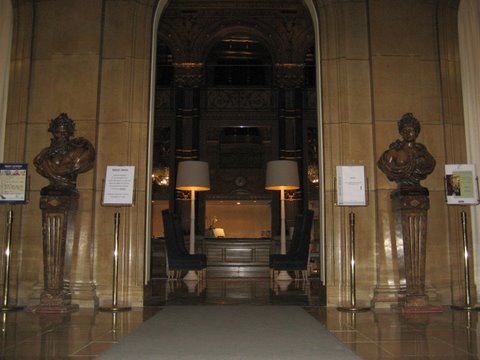
I arrived at Paris in the midst of autumn at 6 am, after departing from Haneda at midnight.  The purpose of this visit is to attend the final jury of 2012 L’Oreal -UNESCO Women In Science Awardees.  A car from L’Oreal picked me up and took me to Hotel Concorde Opera. At the lobby, I noticed quite a number of tourists from Japan in and around the lobby.  Maybe it was because of the good season.  The weather was beautiful, not a single cloud in the sky, and the temperture was around 25-26℃ (77-79F).  I was told that it was rather cold until last week, though.

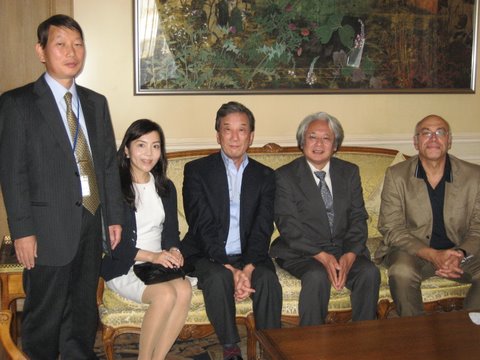
H.E. Kiso, the Ambassador of Japan to UNESCO kindly invited me to his official residence for lunch.  I have been to this place before,  but its been quite a long time since. Dr. Georges Haddad of UNESCO, former President of Sorbonne University (appointed to the presidency at young age of 37) joined us.  He was a fantastic person to talk with, having amazingly broad range of topics including the situation of Japan, and we all had such a nice, enjoyable conversation.

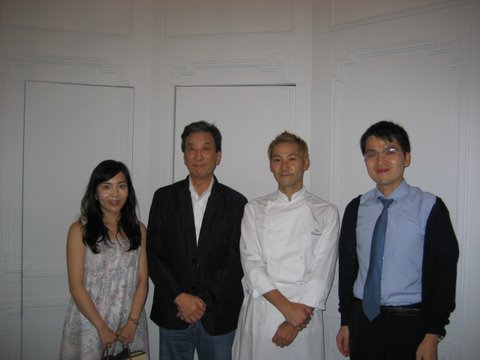
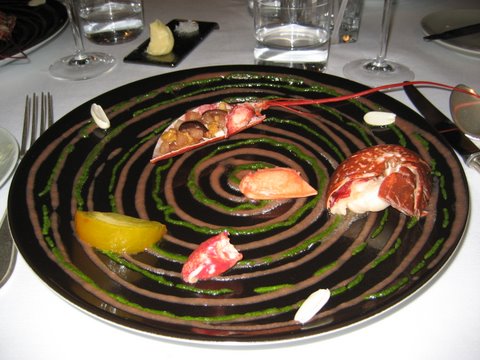
In the evening, I had a dinner at “Kei”, a very popular restaurant recently, with Dr. and Mrs Mimura of American Hospital of Paris.  Kei stands for Chief Kei Kobayashi. I was quite impressed to know his career.  Every dish is wonderful not only in its taste but also in the ways how they are presented.  He certainly well deserves the high reputation.  Why not try this place next time you visit Paris?

The next day was the selection of 2012 L’Oreal Awardees.  The discussion continued for about 7 long hours including lunch time.  After the hard work, we finally succeeded in choosing the 5 wonderful scientists which made us all happy. Participating in this sort of discussions, listening to various views, is very inspiring and there is much to learn from such experience.

In the evening, we enjoyed a concert, which is now a customary event.  We listened to 3 works each by Bela Bartok, Zoltan Kodaly, and Samuel Barber (Piano by Garrick Ohlsson), conducted by  a much loved conductor from Korea, Myung-Whun Chung, who was appointed to the musical director of Orchestre Philharmonique de Radio France for this Autumn season.  I find Chung’s crisp, sharp style of conducting very attractive.

At around 10 pm, after the concert, we stopped by at Drouant.  It was sometime past 1 am when we finally said good bye to each other.  It sure was a long day.

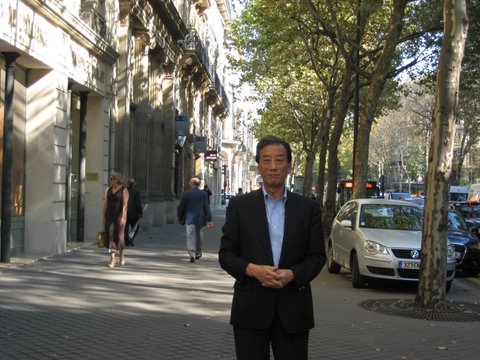
Anyway, whenever I come to Paris, I rediscover its beauty.  People in general are not too overweighed, many smoke on streets or at cafes, and many women are dressed nicely, that is, in a chic style, regardless of their age.

I plan to return to Paris next March for the award ceremony of L’Oreal-UNESCO Women in Science Award.  I very much look forward to coming back to this lovely city.

Board Meeting of Impact Japan

Japanese

Six months passed since we established Impact Japan.  During these months, we all worked together to support various voluntary activities by people categorized as the “out of the box” type, especially the young people, launched a collaborative project with Project Hope for the Tohoku Earthquake, organized an educational program with Harvard College Initiative Japan, and such.

These activities stemmed out rather naturally from the activities with my friends and colleagues, around the time we launched TEDxTokyo.

Please “Google” Impact Japan.   Also, you can find many postings in this (my) site if you search by the keyword “Impact Japan”.

By reading these sites, you will see what we are up to or what sort of activities we are trying to focus on.

Six months have passed since Impact Japan has become an officially registered organization.  We had the first official board meeting recently.  Our Honorary Chairman, H.E. John V. Roos, the Ambassador of the United States to Japan,  honored us with his presence for about an hour and encouraged us with many ideas.

I hope that Impact Japan will overcome many challenges and continue its activities to support the youth, encourage the “out of box” type people, help coordinate all sorts of actions so that in the end they become a strong power to CHANGE Japan.

I thank from the bottom of my heart to all of you who help, support, and work for Impact Japan.  Please, by all means, continue to support us.