Transparency of Information is the Basis of Trust: What is PM Kan’s Cabinet Doing?

→Japanese

Ever since the Fukushima nuclear power plant breakdown, I have been pointing out in my web site that openness and transparency of information is the basis of trust for any organizations, be it government or enterprises. And in the case of Fukushima I regret to say that this openness and transparency lacked to a fatal degree especially in the initial stage.
 
The fall of trust in Japan’s government and authority seems clear to the world, and this openness is the risk shared by all Japan Enterprises in this global world.  Unfavorable rumors or misinformation about agricultural produce or industrial products, thus harming credibility of Japan (‘Fuhyo Higai’ in Japanese), basically originates from this mistrust in Japan.

To address this issue, I pointed out as the “Next Step” (Ref.1,2,3) the importance of launching a Commission/Task Force consisting of independent, international members.

I understand that some legislators recognize the importance of such processes, and their number seems to be increasing.
 
At this challenging timing, domestic politics is seemingly occupied by the ‘storm in a cup’, and I fear that the world is gradually spreading the notion that governance of Japan’s authority is really no good.

IAEA issued a report on the result of its investigation of Fukushima pointing out that the transparency of information and speed of briefing was fatally unsatisfactory.  It is no surprise that they say so.

Such tendency of Japan was being observed internationally for some time at many arenas, but it so seems that they thought it, understandably, was a domestic problem.

However, now, people are being more aware of this weakness as they were pointed out in relation to the response of Japanese authorities to Fukushima and the investigation of that followed.

Below are the recent commentaries for your reference.  I think people involved are well aware of these issues.
1.Comments by Bruno Pellaud, former Director General of IAEA (in Japanese)
2.Credibility of Yukiya Amano, Director General, IAEA , questioned (in Japanese)
3.Comments on the weakness of the Government of Japan (in Japanese)

We must swiftly move on to the next “Step” to regain trust.  No matter what we do, it takes a long time to regain the trust once lost.


Chief Scientific Advisor to the UK Government Visits GRIPS

→Japanese

I have written several times here(in Japanese)(Ref.1)on the Chief Science Advisors to the UK Government.  As the representatives of the scientists of the United Kingdom, they are well trusted by the science community and have great responsibilities to the government in giving advices in their policy makings.  

This post is currently served by Sir John Beddington from three years ago, if I remember correctly.  He is a wonderful person.  I happen to be especially close to his predecessors Sir David King, and Robert May (later the President of the Royal Society, Lord May of Oxford); we trust each other and get along quite well.

This is one of the most highly respected positions in the British Government (Ref.1) (both links are in Japanese), and therefore a person is carefully and well selected to assume the responsibility.  This background is observed clearly in the healthy relations between the science community and legislators – particularly the Prime Minister (although the distance varies depending on the Prime Minister of the time.  Tony Blair, for example, is said to have been quite eager and used to have discussions with the Chief Scientific Adviser almost weekly… I think that, in the end, it is a matter of the level of insights of the top of the administration how they use these wonderful advisors….)

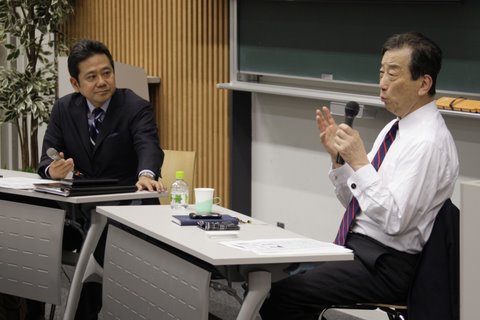
Taking the opportunity of Sir Beddington’s visit to Japan, GRIPS invited him to give a lecture and a panel, and the event was moderated by Mr. Akira Ikegami, a well known journalist/TV broadcaster. The main topic was “3.11 and Fukushima”.  It was a quite nice conference, with lots of participants, good Q&As from the audience and twitter.

I was invited to ask first question to Sir Beddington after his speech.  Its video record is uploaded on Youtube (part 1)(part 2) and summary document is available at these links (Ref.1 in Japanese) (Ref.2 in English) .

His presentation was very clear and good.  I understood very well that he was speaking with full sensitivity to political issues and process.  I hope you will learn a lot from his lecture on how to communicate/work with governments.  On the other hand, I think it would be interesting also to imagine what Japanese people in such a position would say or act if they were in a similar circumstance.

My question appears right in the end of Dr. Beddington’s presentation (I urge you to listen to this…), after a comment by Mr. Ikegami, the host.

Fukushima is a global issue and the lecture was given at the timing when we were waiting for the results of the investigations by the IAEA. 

Good questions were raised from the floor, too.


Fukuzawa Yukichi Memorial School (Juku) of Civilization; Enjoying Dialogues With the Youths

→Japanese

(Photos by Mr. Nobuyuki Aoki of the Change-the-World

Fukuzawa Yukichi (Fukuzawa is the family name) is a leader of the modern Japan, one of the persons I respect very much.

If you search by the key word ‘Fukuzawa Yukichi’, in this web site, you will find several postings on him.  I summarized some of them into my book review “Vision of Fukuzawa Yukichi; His Insights Into the Future at Time of Chaos”  (in Japanese).

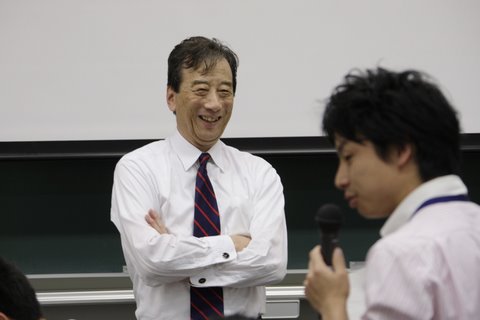
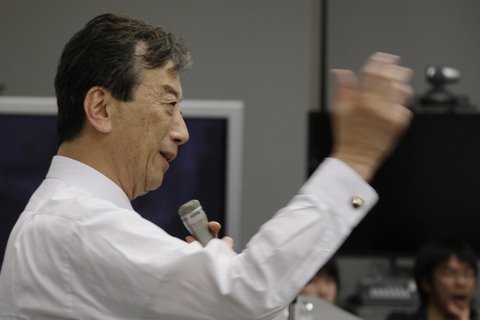
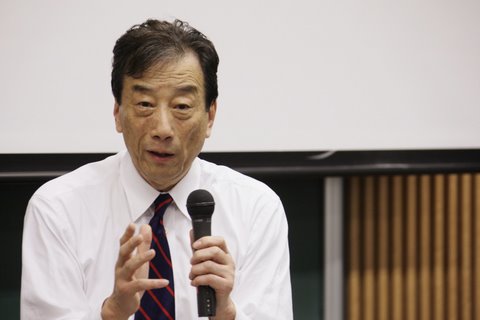
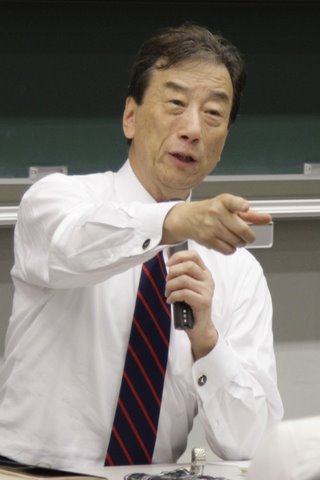
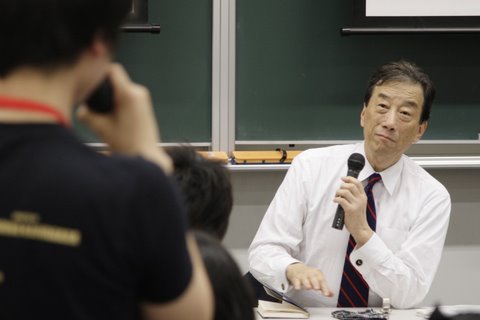
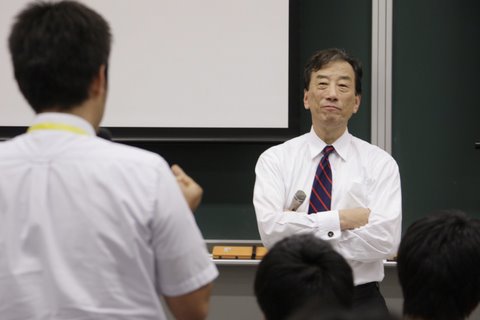
I was invited to a gathering named “leadership” in the “Fukuzawa Bunmei (Civilization) Juku”, a Juku (literally meaning cram/private school) named after Fukuzawa Yukichi, the founder of Keio University.  The program was hosted by Professo Jiro Tamura .

About half of the Juku-class were students, the rest were young people with jobs, but what struck me as a pleasant surprise was that about half of them was women.

The video of the session is presented in u-stream.

I discussed with them in schemes of; the ‘3.11’ and subsequent crises of today, how to see Japan’s response and background, and the need of leaders with global vision.  Participants discussed in a group at some intervals, and raised me questions.

I always enjoy talking with youths very much.


TEDxTokyo 2011

→Japanese

We began TEDxTokyo in 2009 (Ref.1).  This year is their 3rd year.

I reported to you several times also about TED, its home organization (Ref.1, 2, 3 ), here in this site.

This year, however, we quickly changed the theme to respond to the ‘3.11’ disasters.  And it turned out to be a wonderful gathering.

Participants seemed to enjoy the event very much, and I felt that the expectations for the future Japan gradually fermented.

Programs are posted on the web  (for example, search by the key word ‘TEDxTokyo2011’ in the here…)

People have different likings and what you like may be different from mine, but personally, I enjoyed for example;

Black A Yo Yo
Dr Ueno
Gunter Pauli
Kathy Matsui
just to mention a few…

I urge you to visit the site and have fun.

Todd and Patrick were the producer and organizer of this event.  More than 100 wonderful volunteers helped.

Thanks to every and each one of you for your support.


First Step Towards Structuring New Japan

→Japanese

 ‘3.11’ disaster attracted global attentions not only by its huge impact but also by the importance Fukushima has in the world.

However, this attention lasted just for the initial 1 to 2 weeks.  Japan has exposed its strength and weakness clearly to the world, as I have pointed out for several times in this web site (Ref.1, 2, 3 )   
or in other media such as newspapers (in Japanese) (Ref.1)

News coverage of Japan is altogether minor in international media.  If you follow the world news, it is perfectly clear that any comment by Japanese government is taken as nothing but excuses.; that is to say the credibility and trust of Japanese government have fallen.

Then, how can we recover the international credibility of Japan?  This is the keypoint.  As far as browsing through the domestic news coverage, I could hardly find any opinions or comments by the Japanese ‘leaders’ on this issue.

At a time like this, when the nation is at the brink of losing its trust, it is good to learn lessons from the past.  However, that being said, the point is how much the leaders have profound insights, are capable of making good judgments, know what they must do.  Self-centered ‘pride’ means nothing here.
The one and only thing that matters is how much you care about the people (of Japan).  It goes not just for the government but also for the major business enterprises like TEPCO.

This means, in case of the Fukushima Nuclear Power Plant, that the government or the Diet must launch an ’International’ task force that is completely ‘independent’ from the government. I can assure you that unless this is done, the world’s trust in Japan will never even start to recover.

Such idea/reasoning is also presented in the document which the Natural Resources Defense Council submitted to President Obama dated March 25th.

Also, unfavorable rumors or misinformation about agricultural produce or industrial products, thus harming credibility of Japan, are difficult to tone down unless the steps I described above do not materialize. There are lots of lessons to be learned from the process of recovery of the reputation of British Government that took more than 20 years when the BSE started in 1886

What we need is a special committee that is ‘independent’ and ‘outside’ (i.e. internationally trustable) of the government.  Equally necessary is a quick and total information disclosure.  This again, is very unsatisfactory at this stage.  Transparency is the foundation of trust and credibility.

Recently, I had an opportunity to present this idea using this figure at a meeting (open to media) organized by legislators of the Democratic Party of Japan.  I learned that many members of the Diet share this idea with me (in Japanese).

Mind you, the whole world is watching.  They are questioning whether Japan has no intention of turning the Fukushima nuclear power plant disaster to lessons to share with the rest of the world.


St Gallen Symposium

→Japanese

Click here for the photos of St Gallen town

From Washingon DC to Zurich via London Heathrow, and then about 50 min. on car, I arrived at the beautiful town of St Gallen at about 4pm, May 11th.  Swiss in May is beautiful, and the weather is wonderful (but unfortunately it was raining tonight and tomorrow’s forecast is cloudy plus rain).  I took a walk around the town for a while.  Asparagus is in season at the market now.  In the evening, I went to the reception.

This is my third participation at the St Gallen Symposium, first in 2007 (in Japanese) and second in 2008.  The Symposium has a history of 41 years, and everything is organized by the students of St Gallen University.

The purpose of this event is an ambitious one; to invite global leaders in business and other sectors to talk and exchange views with the youths.  The age range of participants broadened a bit from last year- focusing graduate students and young people up to 30 years old from the original focus to undergraduate students, plus a special group of people categorized as the ‘Future Leaders’.

I am very pleased to see more Japanese students coming each year.  Selection of the participants are through submission of English essays. Quite a number of foreign students studying in Japan also join in the ‘Japan slot’.  This is good.

This event is hosted by undergraduate students of the St Gallen University.  They are all dressed properly, very good mannered, and take care of things in a crisp, friendly way.  Their hospitality makes the overall atmosphere quite pleasant.

I think it is wonderful that the students meet many global leaders in person and the future leaders-to-be who are of the same generation as the students.  Through the process of planning this event, they meet many people, effectively broaden views, recognize the difference, or find their own goals. 

The theme of this year’s Symposium was ‘Just Power’  (Ref.1).

I participated in the Work Session2; What values for a world out of joint?   It turned out to be a very lively, enjoyable session because I limited my talk to just 20 minutes, focusing on major prospectives of world affairs, and spent rest of the time in dialogue with the audience.

Then I had a couple of interviews, and after dinner I continued to enjoy talking with young people until late at night (at around 1am).  Basically, I make it my policy to focus on young people in my activities.

The Symposium had many good panels; such as ‘One-on-one: Ribal Al-Assad’ in the morning of 12th,  the two sessions in the beginning of 13th;
‘Mega-Diplomacy’ by Parag Khanna and a panel on 'War and Peace at Edgy Times'.  I learned a lot from these exciting sessions.

I was interviewed by Dr. Khanna (Ref.1) and his wife last year in Tokyo.  They are both journalists/researchers – quite an impressive couple.  His new book ‘How to Run the World: Charting a Course to the Next Renaissance’  published early this year is causing a sensation.  Of course I purchased a copy at once.  It was a pleasant surprise to see him at St Gallen as I was corresponding with him via emails only a month ago, yet did not expect him to see him here.

The panel on ‘War and Peace’ was somewhat humorous since the panelists talked so much making the host to be at a loss.  Dr. Galtungs known for peace and conflict studies was especially outstanding here.  I think Norway is a great country in that it produces so many people such as Dr. Galtungs.  Considering its (small) population, Norway seems to have a high rate of producing such global leader personality as Drs Godal  of Global Health or Brundtland, who serve as the leaders of international arena by continuously working to address the difficult issues of the world.  In a way, it is like having 50-100 Ms Sadako Ogatas in one nation.  I wonder whether this has to do with their being home to the Nobel Peace Prize Conferring Institution, or they have a tradition of dedicating to such activities…
  
By the way, at a meeting like this, the way the participants speak, their expressions, their witty dialogues in particular, are something to learn from.  For example, Q&A session is a very good time for such learning.  Putting aside whether you speak as good as they, being present at such place at an early stage of life provides you a wonderful opportunity to think about your goals, or to realize that there are so many wonderful colleagues just about your age.  There are many opportunities outside, so I urge all of you youths to seize any opportunity, and go out to the broad world.

Browse through the various web sites of the St Gallen Symposium and enjoy the videos and photos.

Sadly, I had to say Sayonara to St Gallen in the morning of the 2nd day, to fly back to Japan.

 

TED -5: Who Decides the Sites that Appear On the List After the Search? The Potentials of iPad Books

→Japanese

Aren’t the titles attractive?  Both are very TED.  They are from the presentations I enjoyed this year.

One is about the sites that are displayed on the list when you make a search on Google.  What sites will be displayed?  What problems exist there?

This question is relevant to the ongoing media coverage or public relations of Japan on the great Tsunami disaster and Fukushima nuclear power plant problems.  It is a 9 minutes presentation by Eli Pariser

Another is about a book.  What sort of books could be created by using iPad?  It is a 4 minutes presentation by Mike Mata.

Enjoy!


Science and Technology Policies in the Mid East: Lecture at The Middle East Research Institute of Japan

→Japanese

There is a membership organization by the name of The Middle East Research Institute of Japan (MEIJ).  The Chair is Mr. Mikio Sasaki, former chairman of the board of Mitsubishi Corporation, and the President is HE Tatsuo Arima  (in Japanese), former Special Representative of the Government of Japan who had done a significant job for many years.

I was invited to give a lecture at its breakfast meeting on current status of higher education and science and technology policy in the Middle East.

MEIJ supported the Japan Arab Economic Forum held in Tunis last December, and I was invited there also.

Most of the members are from business sector, so I thought that my contribution on this theme would be somewhat limited, but I tried to speak as open mindedly and straightforwardly as possible based on my personal experience.

I assume that you already know from my postings on this web site about my activities in the Mid East/Islam such as Egypt, Abu Dhabi, Dubai, or Qatar (please search within this site by these key words..)  I focused my lecture on those activities, their relations with Japan, the revolution that took place one week after my departure from Tunis, and issues between the Mid East and Japan in coming years, particularly after the revolution.

I always appreciate such opportunities, since I learn a lot from exchanging open and straightforward views with people that are in very different areas than myself.

I would be more than happy if I could have other such opportunities.


More and More Dynamic Actions to Expand Links to the World

→Japanese

East Japan Disaster and the actions of Japan to respond to this is a huge challenge which will determine the future of this nation.  The 'strength' and 'weakness' of Japan have been clearly seen not only in Japan but by the people of the world.  I don’t know how well Japanese people understand the background and the basis for those ‘strength’ and ‘weakness’ of Japan, but I do suspect that everyone thinks that ‘something is wrong’.  It goes without saying that ‘transparency’ is the basis of trust in this flattening, interconnected global world.  However, it seems that ‘Japan Inc’ is not disclosing the first hand information nor original data to the public and the stakeholders at press briefings or press conferences.  Subsequently the reactions of the stakeholders will be late, which will trigger damaging their trust to the government, eventually leading to a vicious circle.

For democracy to function, it is indispensable that broad range of information be distributed widely to the citizens, so that they have options to choose from in making decisions.

In this context, I would like to share with you my experience at two unique gatherings.

One is a dinner meeting with Mr. Robert Thompson, the Editor in Chief of the Wall Street Journal (WSJ), Mr. Jacob Schlesinger, the Japan Editor in Chief, their co-workers, and 7 or so of the ‘global minded leaders’ invited from Japanese government, businesses, or academics.  The discussion was heated from the beginning.  Naturally so, because they have been, for a long time, concerned and working to solve the problem of Japan’s so-to-say ‘mal adaptation syndrome’ to the globalization.  Since all discussions are ‘off-the ?record’, I have to have their names remain undisclosed.

By the way, participants from WSJ other than the Editor in Chief and Japan Editor in Chief, were several core staffs who all happened to be females.  These staffs had a very nice impression on us.  ‘This’, again, shows what we need to revitalize Japan.

Another one.  Foreigners working in Japan organized a joint networking event with CCJ- Chamber of Commerce of Japan (I serve this year as the ambassador of the American Chamber of Commerce in Japan …) in support of several NGOs of disaster relief.  The gathering was named ‘Giving Back to Japan’ and many Chambers of Commerce in Japan of the world participated.

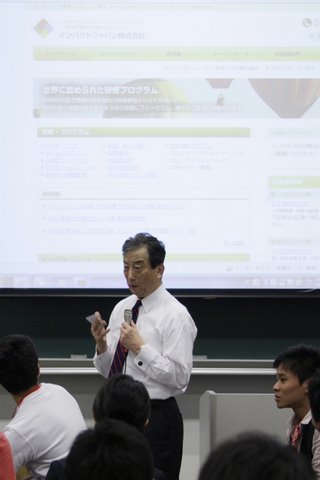
I was given the honor of being invited to deliver a Keynote speech, and so chose the title of ‘Re-inventing Japan’.  This disaster is a ‘crisis’, and we must make it an ‘opportunity’ for not only putting into action many ideas to ‘reform’ Japan that were raised but remained undone, but also for ‘opening up Japan’ to the world.  This is the best way to honor the diseased.  It is crucial that we focus on nurturing ‘Global citizens’  (Ref.1,2)in the process of helping youths build their future career.  I introduced the activities of ‘Impact Japan’ which we founded for such goals.  I was, in return, introduced to people working for the children in disaster hit areas such as KnK Children Without Boarders or PA International .

The reception was very successful.  Another such gathering is scheduled to be held 6 months from now.

Let us cooperate with the people of the world and expand the links of networks – for ourselves and for the sake of youths, who will build the future of Japan.


A Speech in Expectation of Empowering Women

→Japanese

I arrived at Haneda from San Diego early in the morning.  This day, I ended up corresponding all day for the Project Hope.

Supporting system for disaster relief in Tohoku seems to be gradually getting into order, and more aids, although far from enough, are coming in to the stricken areas.  Needs for medical care is changing rapidly.  Now, there are more needs for handling of chronic disorder rather than acute illnesses.  Equally becoming important are mental supports for the children and elderly.

Project Hope decided in the end to go to the stricken areas as well as the Fukushima area.  Everyone is working very hard to contact relevant sections and offices in order to arrange the trip.

Dr. Shimabukuro decided to come back to Japan from UCLA again, and is busy getting into touch with people.  In between, she even wrote an article to USA Today.  Dr Shiabukuro is such a hard worker!

As for myself, I had to give a lecture next day at the luncheon hosted by the ‘Women’s Committee’ of the Tokyo American Club (TAC) on ‘Women Empowerment in Japan’, so to my regret missed the opportunity to go the disaster hit area with our Project Hope team. 

At the TAC luncheon, I was seated next to Mrs Roos, wife of the U.S. Ambassador to Japan.  I had the privilege of talking much about the quake and Fukushima issues with her.  The activities of the Ambassador can be followed via twitter and you will easily see how much he is dedicated.  By the way, all of the participants at this luncheon were women except for myself and Mr Lee, the President of TAC.

I opened my lecture by saying “Thank you for inviting me to TAC luncheon seminar to discuss ‘Gender Empowerment here in Japan.’ But, I must say that I am disappointed because today my audience consists of only women except for me and TAC president and what I speak to you today must be addressed rather mainly to men and you women know well many issues I will be talking about”.  I also distributed a list of references.

I said that the challenge is how to shift from ‘society of men’ to ‘society of gender equality’ and ‘gender empowerment.’.  In fact, Kathy Matsui of Goldman Sachs have written how her analysis show that if the Japanese society succeeded in encouraging women to take good part in workforce, the Japanese economy is expected to grow by 15%.  For details, please refer to ‘Womenomics’ which I included in the reference list.
 
As you may notice, I am raising this issue again and again in this website.