A New Program of Canada

→Japanese

On May 3rd, the Canadian government announced the launch of the new 5 year ‘Global Challenges Canada’ program. 

While this program collaborates with the ‘Grand Challenge Explorations’ program of the Gates Foundation, its major objective is to have Canadian researchers (though not limited) contribute to the improvement of poverty, health, public health, health care of the developing countries that participate in this program.

The program is limited to 5 years but it is an approach to construct a ‘Win-Win’ relationship with the developing countries through new form of scientific technology diplomacy. With and through the outcomes of this program, Canada is apparently trying to strengthen its presence in international agenda.

I am supporting this program as a member of the scientific advisory board,  but in Japan also, I am happy to report that cooperation with the World Bank will possibly be enhanced, Japan’s ongoing aids to African countries were recognized and approved, JICA and JST are continuing its collaborations in a number of projects.

Promoting multi dimensional effort toward MDG and other goals to fulfill the different needs of the developing countries ? from the poorest to the fairly developed ? together with many ongoing bilateral cooperation or multi nation organizations such as the World Bank is very helpful for the good of human security and the realization of MDG.

Also, it will be important than ever before to collaborate with other nations, and exchange information.

There are still many, many things that Japan can do to help solve the problems of the world.

Think for yourself what each one of you can do to contribute. The point is how you see “the world from Japan and Japan from the world”.

‘Asia Vision 21’; by Harvard and NUS, From Singapore

→Japanese

On April 29th and 30th、‘Asia Vision 21’ was held under the auspices of National University of Singapore Lee Kwan Yew School of Public Policy and Harvard University Ash Center.  I have been invited by the Ash Center for several years to attend this Program, but had been unable to until this year.  I am to join the panel on Biotech.

Dean of Lee Kwan Yew School of Public Policy (Ref.1) , Dr. Kishore Mahbubani, is widely known by his books.  Dr. Mahbubani has been quite visible these years around the world, has been a diplomat for many years, and his discerning wisdom is great.  I have introduced him to you in my blog postings (Ref.1) several times in the past.

Participants from Harvard were also very interesting, including the well known Professors Ezra Vogel, and Arthur Kleinman, Director of Asia Center.   I was with Dr. Kleinman this January during my visit to Boston and we enjoyed a rounds of Martini.  I might add that I was quite filled up then.

The two days session was a very stimulating opportunity, particularly to me to learn much about Asian politics and economy in global world since there were so many experts and first class debaters of this field.  I also made new friends, which is one of the many reasons why attending this sort of meetings is such a pleasure and eye-opening.

I slightly regret to have to say that I can not introduce you in full about the speakers and participants since the host maintains a policy not to post the record of this meeting even on web..

I was at the Breakout Session ‘Flashpoints in Asia’ on the 2nd day where there were about 10 participants. The Co-Chairs of the session Professors Astrid Tuminez,  and Huang Jing, both at NUS, were superb as moderators as well as depth of knowledge and thoughts-provoking comments and questions. Various views, insightful observations by expert participants were full of valuable lessons, and I was quite stimulated.  Harvard University is of course a great source of talents, but the National University of Singapore is also attracting wonderful faculties creating quite a vibrant atmosphere of ‘pulling power’..

Immersed Deep in Debt, Japan At The Brink of Default?

→Japanese

In the world, especially in the ‘developed countries’, government spending is soaring up high while economy recovery is still slow (although not as slow as Japan…)  so the increase of national debt is now being a deep concern to many government leaders. 

At EU, Greece fell into insolvency, Spain and Portugal may also become excess debts and the value of Euro is facing crisis.

Economy in Japan still continues to be in bad shape.  Japan has seen hardly any significant GDP growth for these 20 years.  National budget this year consists of more government-bonds than tax revenue, and policies they come up with only demands more public spending.  Japan’s total debt (mostly government bonds) is now close to 200% of its GDP.

Nonetheless, I don’t see any self control in Japan in the way they issue national bonds, and compared to other nations Japanese experts, academics and media are being too diffident in expressing concerns on the national debt of our country.  Could it be because the volume of the dept is too huge (200% of GDP)?  I feel that it looks almost like a ‘drug addiction’ symptom.  On top of that, aging of our population is accelerating making it almost impossible to pay off the debt. The younger generation must be feeling, though vague maybe, more and more insecure and depressed.  I must say that our generation is so very irresponsible.

So-called ‘experts’ of ‘Japan Inc’ used to say until a few years ago that since Japanese people have about 1400 trillion yen in savings etc., there is really no over-debt or even possible default in Japan.  But don’t you feel that such kind of commentaries and voices have not been heard in these days?  Why is this?

In late January this year, the Standard and Poor’s (by the way, it appears to have made some illegal moves again in the ratings of financial institutions in relation to the recent Goldman-Sacks incidence….) lowered the credit of Japan by one rank.  Japanese media stangely reported this only a bit,  which is a mystery to me since this is such a big problem.

Come to think of it, the last time they lowered the rank of Japan (was it May, 2002?) the whole ‘Japan Inc’, made a big fuss out of this down-grading, media reporting on this sensationally, ministry of finance sending letter and advertisements of protests even to foreign media.  For example see this article. Do you remember?  It was very different from what we are seeing now.  Have you thought about the reason why it is so?

So, what is the current status of Japan exactly?  It seems obvious that paying back of debt (200% of GDP) of Japan is already impossible.  So the credit of this nation will inevitably deteriorate, growth in economy is hardly possible…..  Next fiscal year I see no other choice for Japan than to ask other countries to buy significant portion of our national bonds since domestic demand will not cover the whole amount (though having sold them almost entirely domestically was not normal in the first place, generally speaking.)  If this happens, then the interest rate would go up to at least about 4-5%, repaying back of the debt would be even more difficult, government debt would go skyrocket high, inflation will follow; the life of people will be more and more painful.

Japanese politics is miserable today.  ‘The Iron Triangle of Policymakers, Industry, and Government’ (‘Japan Inc’) that has dominated this country for a long time proved itself to be awfully incompetent.  It is not hard to guess what the ‘elites’ at the government and/or ministry of finance are thinking.  They are hardly likely to take responsibility to themselves, they would blame the cabinet (policy makers) for its poor work.  I can see the scenario in which the people of Japan, especially the younger generation, are forced to fall into poverty.  It is such a mess.  I think I can even foresee the steps those ‘elites’ are likely to take in the future.

Recently, Minister of Post System, Kamei raised the maximum amount of Yubin Chokin (savings at the Japan Post Office) to 20 million yen.   Isn’t this strange?  We can even interpret this as some kind of apparent conspiracy of trying to sell national bonds of next year within Japanese market only.  So is this again that same old ‘putting off of the problems’, ‘conspiracy’?  Is this their strategy to survive another one year without raising the interest rate and not causing inflation?  The decision was announced too suddenly which adds to the strangeness.   But, having this done, it is yet quite doubtful the budget of the next year (year 2011) can become toward recovery path.

In the end, the interest rate of Japanese government bond will rise, amount of repayment of the debt will increase, Japan Yen will go down, and hyper-inflation will take place.  Can you see how awful this would be?

With the election of the Upper House ahead, policy makers can not bring up the issue of raising sales tax, can not act to bring drastic changes to the government, can not decide… and the same goes with the government, media, and academics, too.  Even media seems reluctant to send out messages broadly on such a bad and painful issue; I am not sure whether they are being controlled by the government or worrying about the advertisement fees that established companies pay to them.

At any rate, after the economy bubbles burst in Japan in 1990, the interest rate sank to extreme in around 1998, causing a large bulk of our savings to flow overseas, and it is highly likely that those money worked in part as a trigger of the ‘sub prime’.  I suspect that after the sub prime burst the bubbles in the world, our savings will never come back.

Economy in Japan is very much in danger zone now (Ref.1,2). Political leadership have been unable to raise taxes because of coming election, large companies seem unable of doing good job in selecting and focusing.  They are still reluctant to offer key executive positions to non-Japanese or women so there is not much hope ahead.  It’s OK to discuss ‘this and that’, but what matters is action.  Mega companies are also low in spirit and seem to be thinking only about ‘inside’ factors.  I truly feel the necessity of more and more aggressive, positive management such as ‘M&A’.

Internationally speaking, reputation of Japan has dropped sharply, and I even sense the air of ‘not wanting to get involved with’ feelings sneaking into the minds of people outside of Japan.  ‘Weak’ is not the correct word to describe Japanese economy of today, rather it is ‘paralysed’.

I have cited articles from ‘The Economist’ again in this posting as I have done in many of my other columns. The reason for doing so is given in my column of February 15, ‘Toyota’s Problems and Sufferings: Eyes to See From Outside, Hearts to Sense Outside’ .

 

‘Let Us Take Leave of Absence From School -3: ‘Todai Students Won’t Go Abroad to Study’

→Japanese

Starting from April, I have written two columns in a row stressing the importance of ‘Taking Leave of Absence From School’(Ref.1), and how expectation has changed for higher education that is responsible for nurturing future human assets to address the issues of the new global age.

For example, if you wanted to spread your business to the world it would not be easy even to approach to the right place if you do not have personal contacts especially in the emerging new economic sphere of new developing countries.

It is during their high school or university years when youth cultivate their personal contacts.  ‘Boarding schools’ or undergraduate years in England and the U.S. are also included in this time range.  Since Graduate University career are the places where people in the similar field gather and compete, horizontal connections are weaker than undergraduate schools but I understand that number of Japanese students going overseas for graduate school education are also decreasing in recent years…

In the coming global age, ‘horizontal connections’ will expand to become world wide networks that are beyond fields or country borders.  Because of this recognition, many leading universities abroad are trying to increase the number of undergraduate students going abroad for study or experience, as well as encouraging mutual exchange to educate the youth of the world, the future leaders.

The globalization of the world is speeding up, and therefore human networks of next generation, future partners, structured upon ‘personal credit/trust’ ‘beyond profession or organization’ will naturally become a very valuable asset for each and every youth and each nation.
 
Growth in global world depends on the activities of enterprises that recognize its strengths and weaknesses, applying ‘customer comes first’ policy beyond borders.  Especially in a hierarchical society like Japan where ‘Miuchi Shakai (organization where people have a strong sense of belonging)’of men based on systems such as ‘single track career’, ‘lifetime employment’, or ‘seniority based promotion’, it would be difficult for anyone to express different views, and therefore many things do not run smoothly in times of change or crisis as today’s world  This exactly is the weakness that is found throughout many Japanese mega companies or organizations.  In addition, in most cases workers, particulary executives levels. are all Japanese (and mostly male) and this makes the problem even worse.  People may talk about diversity or difference, but the actual status quo is what I have described above.

Just recently I have written about ‘Toyota Problems; Are They Unique to Toyota?’ where I pointed out these same elements of weakness as possible backgrounds.

By the way, while I assume that the University of Tokyo (called as ‘Todai’), as the top university of Japan, is expected to play a role as the driving force for change, Ms Atsuko Tsuji, an editorial writer of the Asahi Shinbun whose comments are always right at the point, posted a column sharing this same view (full text, summary) with me  on April 19th, a week after the welcoming ceremony of the newcomers of the University of Tokyo.

It goes like this.

“●Todai Students Won’t Go Abroad for Study ? ‘Window’ From Editorial Writers’ Office – <Atsuko Tsuji>

●‘Japanese youth do not seek to go abroad’.  People said so for many years.  This tendency seems especially true for the students at the University of Tokyo.

●According to the data of Todai, the proportion of students who have experienced studying abroad is 4.6% in science major and 4.1% in humanities major.  Other universities’ average, on the other hand, is 8.1% and 14% respectively, the difference is more prominent in humanities majors.

●President Junichi Hamada commented that ‘It is partly because the students are too packed with their courses’, but it is also true that more than 70% of them admit that they do not have ‘ability to communicate in foreign languages’.  This reality must be quite a headache for Todai that lists ‘Internationalization’ as one of their top priorities.

●Mr. Benjamin Tobacman studied at Todai for one and a half year after graduating Harvard University.  He also points out that ‘More Todai students should go abroad for study’ but reason for his saying so is not just numbers.

●Tobacman published a book ‘Culture Shock; Harvard vs Todai’ (In Japanese.  Original title; Culture Shock; Harvard VS Todai.  Published by Daigaku Kyouiku Shuppan) in which he compares the education of these two universities based on his own experience.  He says that at Harvard, professors teach students to think by themselves by asking them questions, but at Todai, professors teach students by giving them answers.  This is no way to nurture students that are capable of thinking by themselves.

●Todai, of course, have professors who welcome questions from the students but most of them know the value of discussions between professors and students on equal basis because they themselves have studied abroad.  If more Todai students go to universities abroad, come back to Todai and teach, then students will be given more chances to think by themselves and therefore have higher motivation for studying.

● Perhaps this problem is not just about students or Todai.”

I hear that President Hamada is keen in promoting international exchange between undergraduate students.  Let’s expect Action!

Some time ago, I invited Mr. Tobacman to see me at my office just after he has published his book.  He told me that he was planning to go to China.  I wonder where he is now-still in China?

‘Science, Technologies and Innovation for Development’ of the World Bank and Japan; A Chance for Win-win Collaboration But….

→Japanese

On April 16th, I left Kyoto ‘ISN Nexus’ early in the morning to join the 10am meeting on ‘Science, Technologies and Innovation for Development’ with Mr. Al Watkins and his colleagues of the World Bank at the World Bank Tokyo Office.

I have been involved in this World Bank project since January 2008 which connected us to other ‘places’ such as  TICAD4 in Yokohama,  Toyako G8 Summit, and G8 Science Advisors’ Conferences (Ref.1,2),  moving us forward to ‘vertical and horizontal’ domains..

I have been to Washington DC to give speeches at the World Bank twice since January 2008 (April, 2009 (Ref.1)  andDecember 2009) and participated also in the discussions and workshops.

Details of these 3 meetings can be seen also at the web site ‘Science, Technology, and Innovation’ of the World Bank.

January, 2008 (Presentation)

April, 2009 (Meeting)

December, 2009 (Forum)

As you can see, the web site of the World Bank is getting better also.

In the meanwhile, Japanese science and technology policies are developing nicely, too.  ‘Building bridge of Japan-Africa’ under the ‘Science and Technology Diplomacy’ policy is one example of such efforts.  I think this is very good since the world is changing fast, too.

Bilateral supports (ODA) and supports through multi-national organizations such as the World Bank face a big challenge in adjustments and collaboration – how they adjust and cooperate with each other.

One of the goals of this year’s meeting was to find ways to match the policies of the World Bank and the government of Japan through such process.   I think our meeting was quite worthwhile, but challenging, and Mr. Iwase, Vice-Minister for Policy Coordination (he also participated in the World Bank Forum last December), Mr. Goto of JICA, and many delegates from ministries in charge were present.  You might be interested to know that the ODA policies of Japan are being highly evaluated by the World Bank.  It is truly something very wonderful.  I think we should let people in Japan as well as the world know more about goods things Japanese government does..

It is a well known fact, on the other hand, that Japanese staffs in World Bank are too few in comparison to the proportion of funds Japan contributes to the World Bank.  However, I heard that about 400 Japanese people applied recently to the 4 or 5 posts offered for Japan.  It is a good trend.  I would like to see more Japanese people participating actively not only in such opportunities but in general; at ‘outside’ of Japanese establishments and at various ‘International Organizations’.  It is not only for their own careers’ sake for many Japanese, but also for the sake of the future of Japan.

This world is huge and broad.  Countless opportunities and future friends and partners are waiting for you to work together.

‘Let Us Take Leave of Absence from School’ -1: My Message to the Freshman of Keio University SFC

→Japanese

Keio University Shonan Fujisawa Campus (SFC) organized a series of events to welcome 1,000 freshmen and on April 6th, I was invited to deliver a special lecture for this new class which is a great honor.  After having a brief conversation with Professor Jun Murai (Ref.1) (Dean, Faculty of Environment and Information Studies) and Professor Jiro Kokuryo (Ref.1) (Dean, Faculty of Policy Management), I talked for about 80 minutes at the θ Hall (I was told that the lecture was relay broadcasted at a separate room for people who were unable to be seated at the Hall.) 

SFC is celebrating its 20th anniversary this year.  On April 4th they had a number of events (in Japanese) with alumni and faculty to commemorate its history.  I am very close to several alumni through my work.  Each and all one them are out of ‘Japanese common sense’ and has global careers….  And what makes it unique about SFC is that being ‘out-of-box’ does not seem so strange. I had an opportunity to hear about their future plans as well.

Their home page introduces the history of SFC, how it is like today, its campus, etc. and I am sure you can easily imagine how nice this university is.

I understand that about 18% of the newcomers are from overseas and a high percentage (about 40 to 50%) of the Japanese students have experience of having lived abroad.   The students are encouraged to study abroad while they are enrolled at SFC and they are also planning to make it possible for students to graduate by finishing all courses in English starting from next year.

My lecture will be uploaded in their web site, too.  In the latter half of my lecture, I showed in my back a series of views that were relevant to the content of my talk.  

By the way, I am making it a rule for these couple of years not to use power point slides at lectures (with 2 or 3 exceptions).  Why?  Well, it depends on what you are talking about, but to begin with, policy makers don’t use slides.  Have you ever seen President Obama or former Prime Minister Koizumi giving speech using slides?  I assume not.  So this is why.  The point is how you communicate the core message effectively.  After all, I am not presenting the outcomes of my research, so that is most important for me.

In my speech, I focused on the globalization of the world and the challenges that Japan face today along with background information such as Japan in 1992, the year most of the newcomers were born, and the overview of the changes of the world during these years.  This is the theme that repeatedly appears in various ways under different titles in my web site. 

Especially, most of the (Japanese) men used to be caught in the common thinking that ‘a Single Track’ career is authentic.  Women, on the other hand, were free to take ‘multiple tracks’ because the single track system did not benefit them ? they cannot go higher, especially in the latter part of career.  So, in recent 20 years, i.e. since about the time when these new students were born, we saw many women who succeeded in making most of their own ‘personal talents’ at overseas.  Men have more difficulty in spreading horizontally because their thinking and actions tend to go inside even they felt (or maybe they don’t feel so….) that something is wrong about their ‘Single Track’ career in our ‘Tate shakai (Hierarchical society)’.  

An Encouragement of Learning (Gakumon no Susume)’ (1876) by Yukichi Fukuzawa, the founder of Keio University was apparently the standard in modern Japan after the Meiji Restoration (Meiji Ishin).  Today in this global age, however, I don’t think it necessary for undergraduates to graduate in 4 years.  Take 5 years, and spend total 1 year (could be divided) doing social activities, studying abroad, getting involved in activities at overseas, living in various countries, travelling.  Go ‘Out’, feel and sense from ‘Outside’ and look at your ‘self’, see and learn the many aspects of the world, feel the difference, and hence see and feel Japan from ‘Outside’.  Through such experience students will make friends, relationships at multiple layers of the society, internationally.  Through such experience they will acquire sensibility to feel ‘difference, diversity’ that exists in this world. It is such sensibility, ability, human networks that enables youth to find their mission, their value to address to this global world.  It is for this reason that I propose “Taking Leave of Absence from School in College or Undergraduate”.  

To begin with, I don’t see much promising future in any enterprise that seeks to ‘informally hire students at their 3rd year of undergraduate school.’  Judging from global standard, Japanese society that gives higher evaluation to such universities and companies is very exceptional.  I honestly want people at ‘higher ranks’ in the Japanese society to wake up.  It’s about time.

In the end of my speech, I introduced just a part of‘my favorite 14 minutes speech’, by Steve Jobs, the icon of IT who brought about drastic changes to the world through invention and production of Mcintosh, iTune, iPod, iPhone, iPad, etc., which was delivered at the commencement of Stanford. I then I wrapped up my speech.

After the lecture, I had a wonderful time talking with many, many students who gathered around me.

I also received many powerful messages responding to my 3 tweets in twitter http://twitter.com/ which I have sent out during my rail travel from home to the campus.  This was a nice surprise, too.

From Accra, Ghana – 3

→Japanese

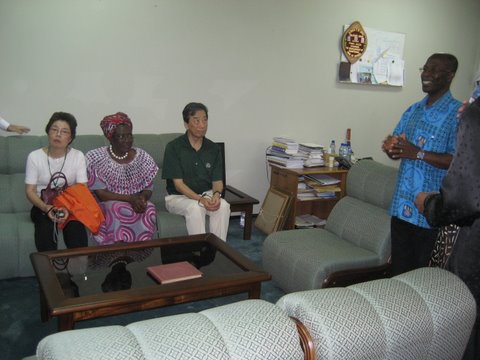
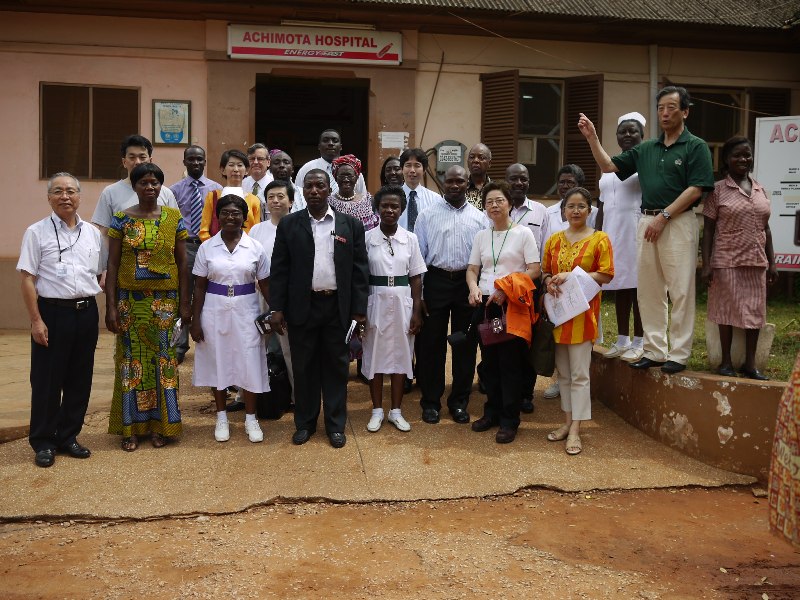
March 10th started with a visit to Achimota Hospital (Photo) located at the suburb of Accra.  The hospital stands within the site of Achimota School the most prestigious school of Ghana established in 1927.  The school is known for producing a large number of talents through its high ideals as manifested in its school emblem; that (starting in the context of school life), black and white, male and female, should integrate and combine synergistically for the good of all.  This idea was revolutionary, especially in the 1920s when the school was established.  Achimota hospital used to serve to this school.  Many African leaders including three presidents of Ghana after independence are alumni of this school.  Achimota school reminds us that nurturing human resource through a long-term vision is always, in any time of history and any nation, the highest priority.

By the way, it is so a ‘British’ style that they have a Golf Course here.  It is the distinguished Achimota Golf Club.Top schools in Britain and U.S. often have golf courses within their school premises.

At the hospital, many nurses are working together with the director and doctors (there are four Doctors).  They have one computer for the whole clinic.  Patients are moved to larger hospitals in the city if surgical operations are needed.  About 200 pregnant mothers visit the clinic every day.  While we were there a baby was newly born. We were with Drs Greenwood and Were and all hospital people, nurse and patients, were happy to see Dr. Were being so popular.  She is truly the heroine of Africa.

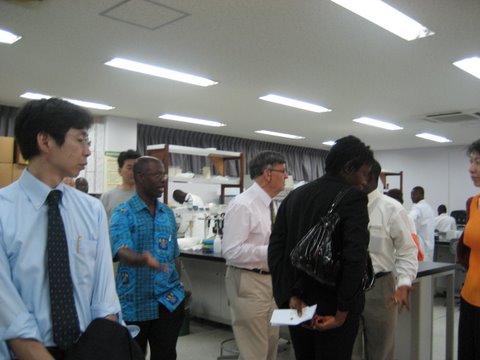
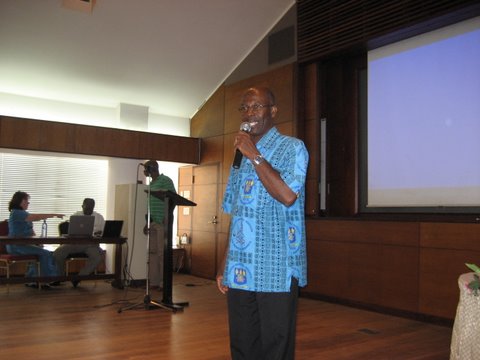
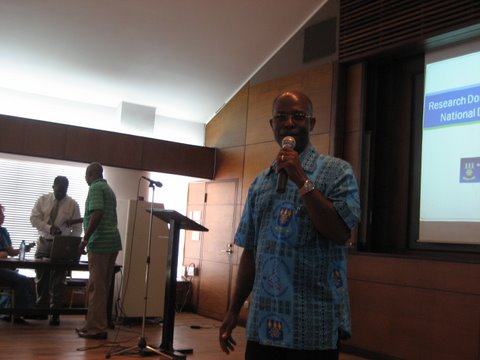
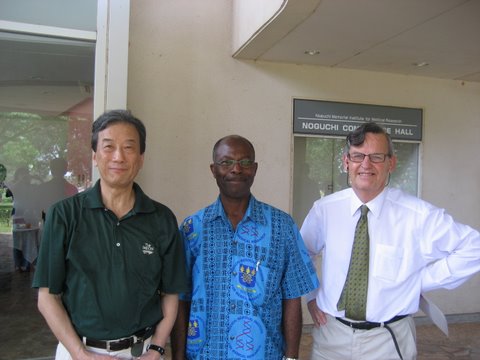
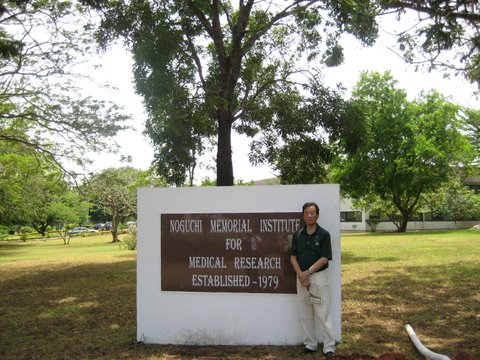
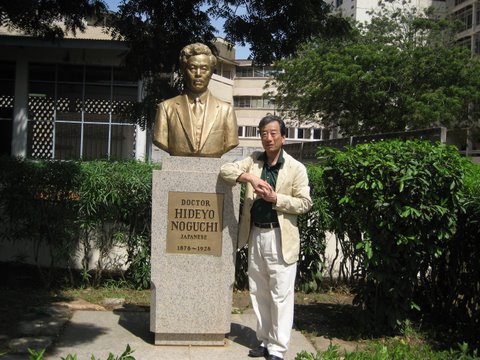
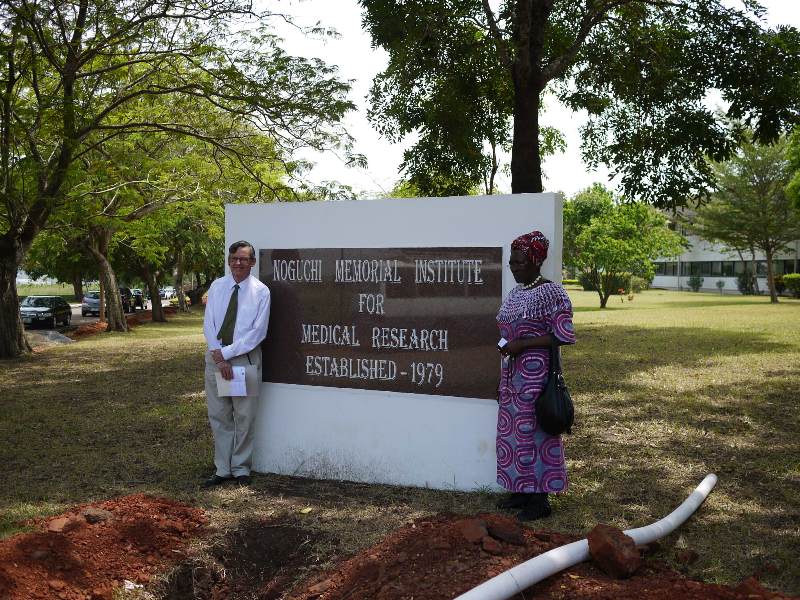
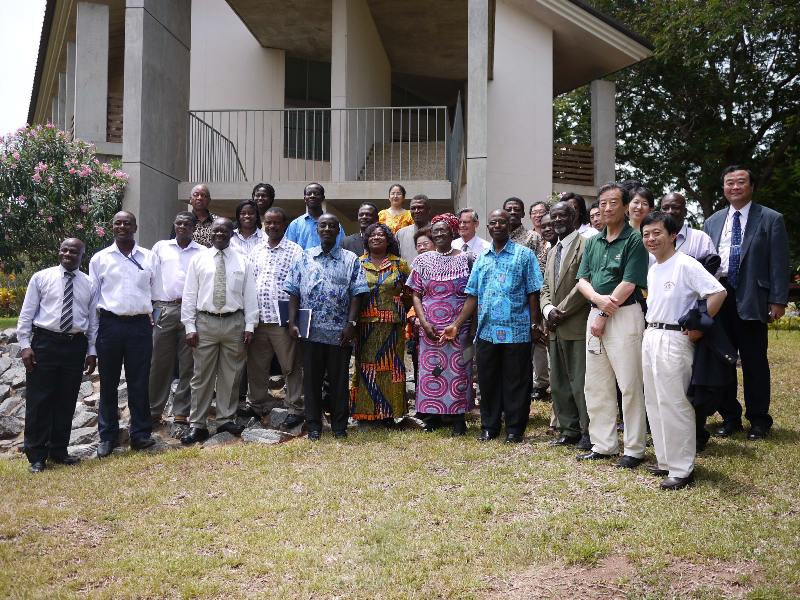
We then moved on to ‘Noguchi Memorial Institute for Medical Research’ established by the government of Japan. (Photos are included in the slide show above).  The Institute is located within the huge premise of University of Ghana (Ref.1, 2) at Legon, the suburb of Accra.  Scientists from University of Tokyo and Medical and Dental University are participating in researches on HIV/AIDS, H1N1, and so on.  It is very encouraging to see the progress of research projects moving.  I fully enjoyed the tour of the institute as well as active discussion with the scientists.

At lunch time, I looked up at the sky and incidently saw the ‘Circle Rainbow: Halo, (Photo on top) a rainbow around the sun just above us.  It was a nice surprise.

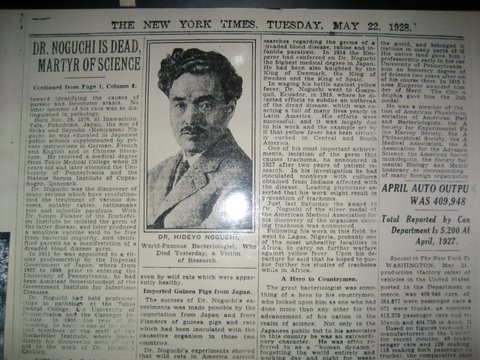
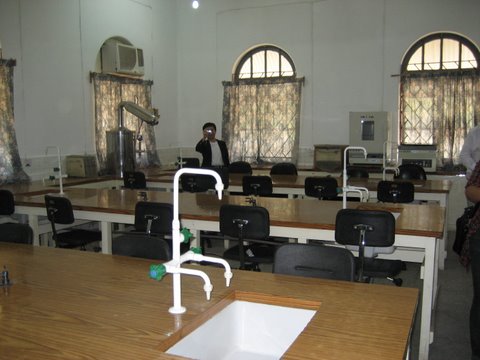
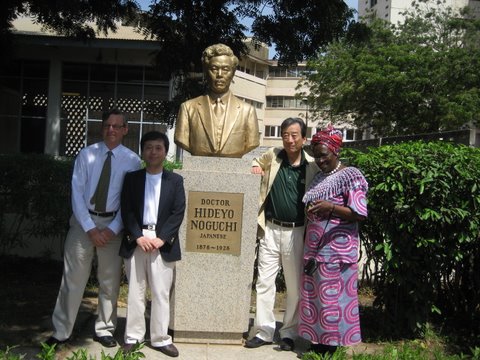
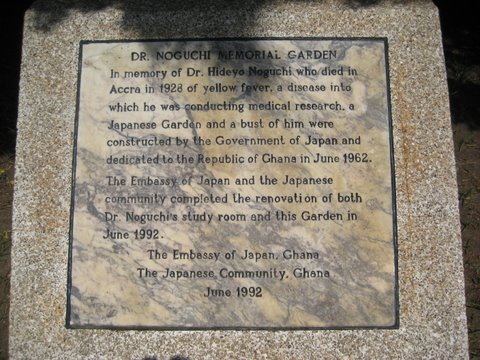
Leaving the Institute, we headed to next destination, the laboratory used by Hideyo Noguchi 82 years ago.  HIH Crown Prince has been here just a day before.  The lab is part of the University Hospital of University of Ghana in Accra city, separate from the Legon campus.  I noticed the signatures of HIH Prince and Princess Takamado in the guest book dated 1993.   What was it like to be here 80 years ago, I wonder.  Among the exhibition was a telegram sent from Hideyo to his wife in New York City.  The telegram was sent by
‘Western Union’ a telegram and communication service company which I wrote about in the context of ‘Japan as a closed country’.   Of course, I saw ‘Western Union’ offices here and there in Ghana and Botswana as I traveled.   The service is operated throughout the world except 5 countries including Japan.  This is truly a strange situation for a country like Japan.

In the evening, I was invited by HE Ambassador Katagami to a dinner at the Embassy of Japan.  The embassy was beautiful with a large garden.  This day the weather was not too hot which was a treat for us.  ‘Takai’, a specialty of Ghana was served as digestif.   The taste was somewhat like Tia Maria, very nice, and I had to control myself from asking for too much.

By the way, Ghana is known for produce of cocoa.   It is the nation’s major industry.  Also, oil was discovered at Off Shore recently.  ‘Ghana’ chocolate is very popular in Japan, but here the chocolate will not melt even at this high temperature.  I was told that its taste does not match Japanese or many people, thus may not have commercial value..

Late in the evening, I left to Accra airport heading for Narita via London.  I have traveled 18 days since February 23th and thia last leg is for two nights on the plane.

Now this trip is coming to an end.

From Accra, Ghana – 1

→Japanese

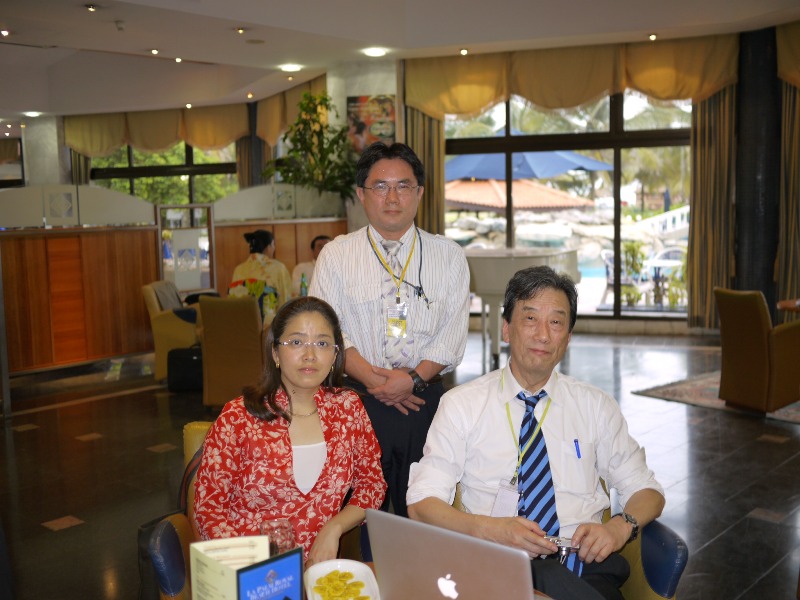
On March 7th, I left Paris, flew via London to land Accra, the capital city of Ghana, at 10pm.  Accra is located at ‘Latitude 4゜33’00’’ North, Longitude 0゜12’00’’ West’ , an equatorial position, almost ‘0, 0’.  The instant I was out of the aircraft, I felt a very, very, ‘hot, sultry’ air.  ‘La Palm Royal Beach Hotel’ that stands besides the coastline, is the venue of the meeting and also our accommodation.

This visit is to serve as the Chair of ‘Hideyo Noguchi Africa Prize Symposium’.  The Prize was inaugurated two years ago as the first and only prize under the auspices of the government of Japan.  We had the honor of the presence of HIH Crown Prince of Japan at the symposium.  I understand that this is his first visit to Sub-Sahara.  The winners of the inaugural Award, Drs Greenwood and Were also participated.

Mr. Yohei Sasagawa, Chairman of The Nippon Foundation who is hopping all over the world tirelessly and Professor Kiyoshi Kita of University of Tokyo also joined with us.  It’s been a long time since I saw Dr Kita last time – a nice and encouraging reunion.

On 8th, I had discussion with NIH Fogerty Program, Japanese delegates of Ministries of Foreign Affairs and of Health, JICA, etc., Professor Nobuo Oota of Tokyo Medical and Dental University with other Japanese scientists working at Noguchi Institute, some of African experts participating this Symposium and so on to discuss and draft possible inputs to the agenda on ‘Global Health’ of the G8 Summit which will be held in Canada this year.

At the Davos meeting of January this year, Prime Minister Harper stated that ‘Maternal and Child Health’  be an agenda of his G8 Summit.  Japan has been making a great contribution in this area (‘Global Health’) since it set the foundation of Global Fund at the 2000 Okinawa Kyusyu G8 Summit as the host, and again its follow ups at the 2008 Toyako Summit.  Especially when we take into account the fact that this year’s Summit may be the last ‘G8 Summit’ along with the poor progress of MDGs, I am but concerned how ‘Global Health’ will develop after the ‘G8 Summit’….

In the evening, a reception was held welcoming the two Laureates, participants from Africa, Ghana, Japanese delegates from Cabinet Administration Office (Naikakufu), Ministry of Foreign Affairs, Ministry of Health, JICA, etc.   Anyway, the hot, soggy climate here is overwhelming.  I sweated all the time.

From Paris – 2

→Japanese

After the evening of L’Oreal Award, I visited American Hospital of Paris (AHP) next morning to see Madam Christiane Guerlain (famous perfume), a member of the Hospital's Board of Governors since 1977, with other members of the Board, Mr John Crowford, Drs Bloch, the head of the Hospital, Drs Kyhayat, and other staff Drs Bard, Matsushita, Mimura and so on.  After listening to them, I was guided to a tour to its major facilities including the new Dialysis Center.   Dr Mimura, a newly appointed Japanese Doctor at AHP from last autumn to lead its Japanese section, is apparently earning good reputation and I was happy to feel the welcoming mood among his colleagues and staffs.

In the afternoon, I had a 2 hours’ teleconference on Global Health with 10 people or so from Canada and other countries, then from 4 pm, joined two executives in charge of technology from Schlumberger Paris head office (I understand that one of them, Mr Ashok Belani from India is the youngest of all board members).  We had quite a stimulating conversation/discussions over interesting topics including possible international collaboration with Japan on global issues.  Schlumberger has placed a branch office in Japan  30 years ago and has been active in many areas ever since.

In the evening, Drs Jean-Louis Armand and Yves Mieux who used to work at the Embassy of France to Japan, Drs Mimura (husband and wife) and I went out to have dinner at KGB ‘Kitchen Galeise Bis’ (Ref.1), a nice restaurant that is quite popular recently (reservations are full 3 to 4 weeks ahead, I was told).  Menu was original and interesting, and everything was so delicious.  The reputation did not betray us.  So, naturally we enjoyed conversation with high spirits.

The next day was Sunday.  HE Ambassador Hattori of OECD invited me for lunch at his residence which was a very relaxing experience.  I have had the honor of knowing him since he was the Ambassador of Japan to Vietnam when he supported us in many ways at Science Council of Asia which we held at Hanoi.  It’s been a very long time since then, and I thank him so much for his unchanging kindness

After leaving his residence, I spent time at Musee Bourdelle  (Ref.1) enjoying the exhibition of ‘Isadora Duncun’.  Musee Bourdelle is a compact but beautiful art museum.  Ms Duncan is a highly unconventional dancer born in San Francisco having performed mainly in Europe and Russia.  I assume people may describe her today as ‘a scandalous, eccentric woman’.

Duncan socialized with Rodin, sculptor, and his close friend Carrier, painter so the exhibition included sculpture of Isadora by Rodin as well as sketches by Carriere and Bourdelle.  The fact that Rodin and Carriere were very close friends is well known and I have mentioned it in my keynote lecture on ‘Molecular Imaging’.  I also summarized the lecture in a essay.  
 
Next noon I took a flight from Charles de Gaulle CDG airport heading to Accra, Ghana via Heathrow, London.

Paris is always beautiful.  There are so many interesting places to visit.  It is such an attractive city.

I have traveled for more than two weeks, visited two African countries, worked in Paris, and had some private time in Bourgogn to enjoy (which I haven’t have had for a long time).

From Botswana to the Center of French Wine

→Japanese

March2010 Burgundy 010
Romanee Conti

After spending 5 full days in Botswana, I said farewell to this charming nation to the next destination in the evening of February 28th.  By the next morning, March 1st, I was at Paris CDG airport via Johannesburg.  Took TGV to Dijon(photo 1) then from here to the center of Burgundy wine.   Then got on a car to run throughRoute des Grands Cru stopping by at ‘Romanee-Conti’ (only about 1.8 hectare…)(photo top and 2), everybody’s dream, and finally arrived at Savigny les Beaune, the heart of Burgundy wine .  Here the vineyard spread for more than 40km!

In the afternoon, relaxed at one of the local wineries ‘Simon Bize et Fils‘ (Ref.1) (Photos). Time passes slowly here.  We enjoyed various good tasting wines.
Next day, we spent half day at Beaune ‘The Center of the Burgundy Wine’ (Photos)  This town had good soothing atmosphere, good food, sweets, chocolates…  We had lunch at ‘Caves Madeleine’.  As you can imagine from her name Mrs. Rika is Japanese.

March2010 Burgundy 006 Photo1To Dijon by TGV

March2010 Burgundy 008 Photo 2 Romanee-Conti

March2010 Burgundy 064 

Caves Madeleine、Madame Rika and her husband Monsieur Rawland.

Food is all nice and fresh here and wine is of course local product..  Here, life is so nice.  I saw several Japanese youths in apprenticeship of wine making and other jobs.  There were some who even plan to stay here for living.  It is encouraging to see those focused and determined young people.

‘Hospices les Beaune’ (Photos)  a hospice known throughout the world, was established in 15th century in this town.

And of course this place is famous for Dijon Mustard.

I will stay here for two nights before leaving for Paris, my next destination.