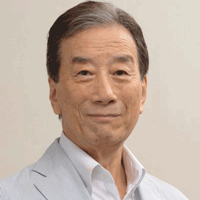
私が今年始めから何度も様々な場所で言っている「大学の大相撲化」ですが、とうとう日経新聞の11月4日(土)の朝刊一面に記事タイトルとして取り上げられました。うれしいですね。「大相撲化、オオズモウナイゼーション」というのです。これは私が英語の講演でよく使う言葉です。
伊藤譲一くんという友人がいます。彼はITベンチャー起業、blog等の分野で活躍しています。日本よりはむしろ海外で有名で、先日のNewsweek日本語版(10月18日)の「世界の尊敬する日本人100人」にも出ています。彼のblogは世界でも最もヒットの多いものの一つです。
彼も私の「大相撲化」コンセプトに共鳴してくれていて、CNN Money.comの “THE CURIOUS CAPITALIST”というコーナーに、彼のコメントが取り上げられています。
Monday, October 23, 2006
Joi Ito’s take on outsiders in Japan
In my interview with Michael Zielenziger about his new book on Japan, Shutting out the Sun, we discussed the role of such business mavericks as management consultant Kenichi Ohmae, tech mogul Masayoshi Son, and blogger/investor/ Gnome Mage Joi Ito. Michael’s take was that they remain marginalized. Joi e-mailed me this morning to say he didn’t entirely disagree. But I’ll let him tell you:
In some ways I agree with the characterization and in some ways I don’t. The "old guard" of Japan is not some monolithic single group, but rather a complex web of various interdependent networks. I think Ohmae, Son and myself all have various connections to various segments of the "old guard".
Japan very often takes "outsiders" and gives them access under the right circumstances. Sumo is an interesting example that my friend Kiyoshi Kurokawa often uses. Even though Sumo is one of the most traditional Japanese activities, recently there is a fairly large number of foreigners. I don’t remember the exact figures, but there is a single digit percentage of sumo wrestlers that are foreigners. What’s interesting is that there is a double digit number in the top tier and 100% of the champions are foreign.
This is not necessarily generalizable, but it is often the case that a lot of your influence in Japan has a lot to do with just how much time you spend focused on developing relationships. I am cyclical. I spend several years outside of Japan, running around, then I focus on Japan to rekindle relationships…
But it is true that the most powerful Japanese power brokers are people who live in Tokyo and have never spent a single minute not focused on developing and managing their power base here. On the other hand, I don’t think it is that dissimilar in other countries. Also, I do think that "changing Japan" is REALLY hard. I’ve tried it a number of times and I think it requires a revolution. Single individuals can’t do it and in many ways I’ve given up. I think a lot of it will have to do with timing. I try to keep an eye on everything in Japan with enough activity to jump into stuff if an opportunity opens. However, I have decided, as many others have, that putting all of your eggs in the Japan basket is risky, frustrating and reaches a point of diminishing return in many cases.
皆さんはどう思いますか?